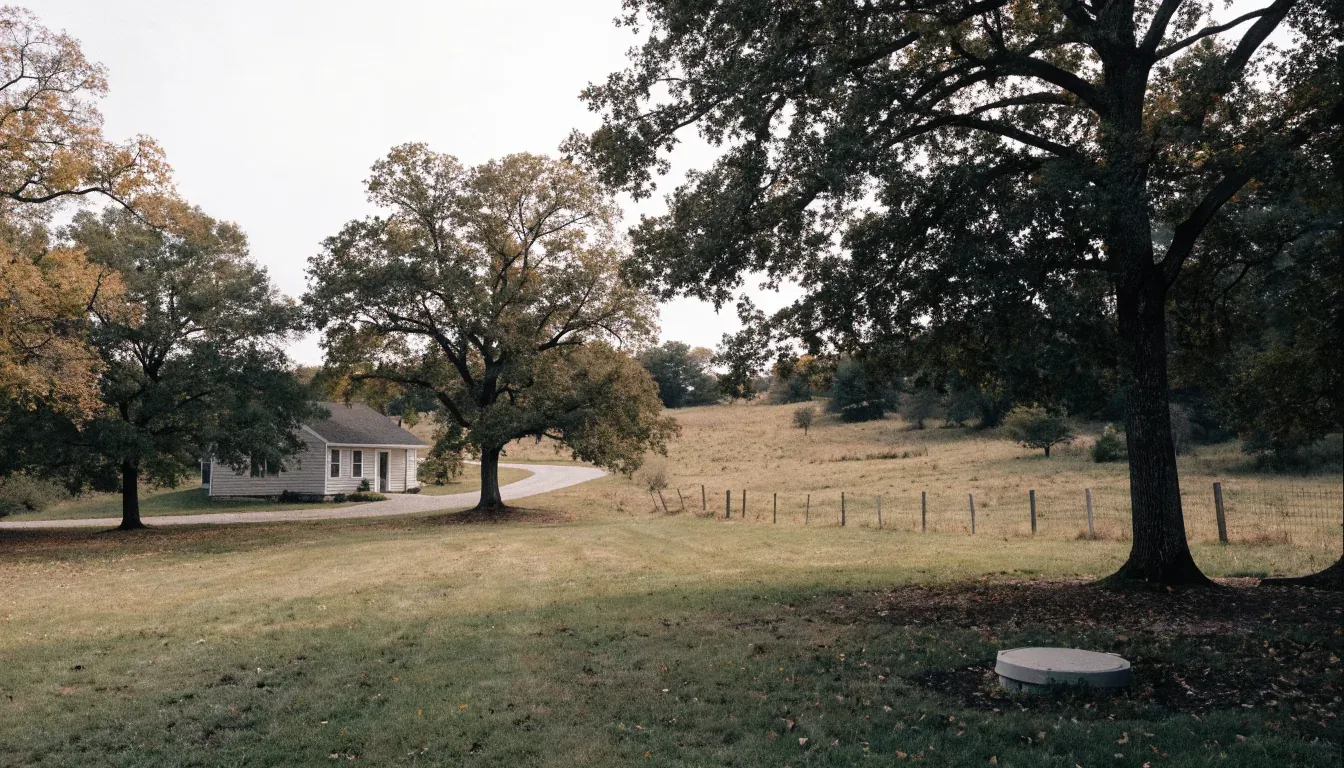

Septic tank replacement in the St. Louis, MO metro
Three different jobs get called replacing the septic tank, and they are nowhere near the same piece of work: the tank alone, the absorption field, or the whole system. Missouri treats all three as major repairs, which as a rule means a construction permit and a registered installer, with one narrow large-lot exclusion in the state statute that your county can override anyway. And in St. Louis County you often cannot put back what came out, because the code requires every individual system to run its sewage through a mechanical treatment plant.
What are the three jobs people call replacing the septic tank?
Naming the right one before you take a quote is most of the work. A contractor pricing the biggest job when you needed the smallest is answering the question you asked. All three are major repairs under Missouri law, which as a rule pulls them into permitted work.
Tank replacement. The tank is failing: a collapsed baffle, a cracked or crumbling lid, a steel tank rusted through, or a tank too small for a house that gained bedrooms. The field stays where it is.
Absorption field replacement. The tank is sound and the field is not. Effluent surfaces over the trench lines, or the tank backs up within days of a pump-out. New trenches get built, often elsewhere in the yard.
Whole system replacement. Both ends are finished, or the permitting office will not approve a partial fix on a system that no longer meets current code. A new build on an existing lot.
Missouri defines a major modification or major repair as redesigning and altering an onsite sewage system by relocating the system or a part of it, replacing the septic tank, or constructing a new absorption field. Source: Section 701.025(6), Revised Statutes of Missouri, read 2026-08-26.
How do I tell which one I am facing?
Have the tank pumped and opened. It is the cheapest diagnostic available, and the symptoms point in different directions.
Wet ground or sewage over the trench lines, with the tank at a normal level, points at the field.
Slow drains and a tank that refills within days of a pump-out point at the field too: it is not taking flow.
A tank that pumps down and stays down, with the trouble visible at it (a lid that flexes, a rusted steel wall, solids past a broken baffle), points at the tank.
Solids on the outlet side or in the line to the field mean a failed baffle, and a field that has been taking solids for a while.
No symptoms, but a house that gained bedrooms or a finished basement, is a sizing question rather than a failure. St. Louis County sizes an individual system by bedroom count, so a changed count changes the capacity the code requires. The sizing rule is on the St. Louis County, MO permit page.
Minimum treatment plant capacity in St. Louis County is 120 gallons per bedroom per day or 1,000 gallons, whichever is greater, and it must be sized by an engineer. Source: St. Louis County Revised Ordinances, Chapter 1103, adopted Uniform Plumbing Code Chapter 22, sections 22.9.3 and 22.9.4, read 2026-08-27.
Does a replacement need a permit and a registered installer?
As a rule, yes. Missouri's definition of a major repair covers relocating an onsite system or part of it, replacing the septic tank, and constructing a new absorption field, so all three jobs above sit inside it. That means a construction permit before work starts, plans in for review before the permit issues, and an installer registered with the Department of Health and Senior Services. Registration is not a license. This site does not check any contractor against that list, so ask to see the registration and confirm it with the permitting office.
The state statute carries one exclusion and it is narrow. Section 701.046 opens "Except as otherwise provided in section 701.031", and 701.031 excludes owners of a single-family residence lot of three acres or more, and of a residential lot of 10 acres or more that meets a separation and density test, from sections 701.025 to 701.059 and the rules made under them. The conditions bind: every point of the system more than 10 feet from any adjoining property line, and no effluent reaching an adjoining property, contaminating surface water or groundwater, or creating a nuisance. It does not reach lots adjacent to lakes operated by the Corps of Engineers or by a public utility.
Do not read that as no permit. A county may regulate under its own ordinance regardless, the local rule can be more restrictive than the state standard, and the collar counties around St. Louis do exactly that. St. Louis County stacks its own installer credential on top, and the county homeowner permit does not reach septic work, so you cannot pull it yourself. Assume a permit is required until your county's office says otherwise. Who permits what across the six counties is on the St. Louis metro septic page.
Except as provided in section 701.031, no person may construct or make a major modification or major repair to an onsite sewage disposal system without first notifying the city, county or department, completing an application on a form provided by the department, submitting the application fee in the amount established by that city, county or department, and obtaining a construction permit. Source: Section 701.046, Revised Statutes of Missouri, read 2026-08-26.
The owner of a single-family residence lot of three acres or more, or of a residential lot of ten acres or more with no single-family residence onsite sewage disposal system within three hundred sixty feet of any other and no more than one single-family residence per ten acres in the aggregate, is excluded from sections 701.025 to 701.059 and the rules made under them, including the provisions on construction, operation, major modification and major repair. The exclusion does not reach lots adjacent to lakes operated by the Corps of Engineers or by a public utility, and it applies only when all points of the system sit more than ten feet from any adjoining property line and no effluent enters an adjoining property, contaminates surface water or groundwater, or creates a nuisance as determined by a readily available scientific method. Source: Section 701.031, Revised Statutes of Missouri, read 2026-08-26.
Any person installing onsite sewage disposal systems shall be registered to do so by the Department of Health and Senior Services. Source: Section 701.031, Revised Statutes of Missouri, read 2026-08-26.
Where the permitting authority rests on a local ordinance, the local regulation can be more restrictive than the state standard, so the local authority is the one to check. Source: Missouri Department of Health and Senior Services, Onsite Wastewater Treatment, read 2026-08-26.
St. Louis County requires an installer to hold both the Missouri DHSS credential for private sewage systems and a county master drainlayer license, or to work under the direct supervision of a county-licensed master. The county homeowner permit is limited to one bathroom, one water heater, or eight drainage fixture units. Source: St. Louis County Revised Ordinances, Sections 1103.P-148(2) and 1103.P-130, read 2026-08-27.
What am I not allowed to put back in St. Louis County, MO?
A plain septic tank discharging straight to a field is not this county's design. The county plumbing code requires all water-carried sanitary sewage to pass through an approved mechanical sanitary sewage treatment plant before it discharges into the soil. Pull out a failed 1970s tank here and you do not get to set the same thing back in the hole.
That plant comes with its own conditions on approval, engineer sizing, access and ongoing service, set out on the aerator and pump replacement page.
St. Charles County catches owners from the other side. New lagoons are not allowed there, so a failing lagoon cannot be rebuilt as one, and a new onsite system needs a minimum of three acres countywide. An older system on a smaller lot predates that rule, and predating a rule is not a right to be replaced in kind.
Check the sewer first: St. Louis County deems a sanitary sewer available when a line runs within 200 feet of any part of the property and requires connection instead, and the metro's sewer boundary and connection rules sit on the St. Louis metro septic page.
All water-carried sanitary sewage in St. Louis County must pass through an approved mechanical sanitary sewage treatment plant before discharge into the soil, and an individual system is defined as that plant discharging into an approved subsurface disposal field. Source: St. Louis County Revised Ordinances, Chapter 1103, adopted Uniform Plumbing Code Chapter 22, sections 22.1.7 and 22.3.4, read 2026-08-27.
St. Charles County requires a minimum of three acres for a new onsite wastewater treatment system countywide, and does not allow the installation of new lagoons. Source: St. Charles County, Onsite Wastewater Treatment Systems FAQ, read 2026-08-26.
A sanitary sewer is deemed available in St. Louis County when a sewer line is within 200 feet of any part of the property to be connected, and every premise with drainage piping shall connect to a public sewer where it is available. Source: St. Louis County Revised Ordinances, Chapter 610, Section 610.080, read 2026-08-27.
What happens if I replace the tank in front of a failed field?
You pay twice. It is the most expensive ordinary mistake in this trade, and it happens because the tank is the part people can picture. A new tank does nothing for a field that has stopped accepting effluent: symptoms return in weeks and the field gets replaced anyway.
The two failures are linked, which is what makes the mistake easy. A field usually fails because a broken baffle let solids into the trenches, sealing the soil interface. So the inspection that finds the tank problem is the one most likely to find the field problem. Ask for both in writing before anything is signed.
The field may also not be rebuildable where it sits. St. Louis County requires at least 400 square feet of absorption area, sizes the field off the percolation rate, and past 45 minutes per inch an alternate system has to be considered instead. Western St. Louis County sits on Mississippian limestone under a thin, variable cover, and the code shows it: no tank or absorption system in the drainage area of a sinkhole, 50 feet of setback from a surficial sinkhole edge for the tank, 100 feet for the disposal area. A yard with room for a field in 1974 may not have room for one that meets today's setbacks.
In no case shall less than 400 square feet of absorption area be provided, and the field is sized per bedroom by percolation rate: 200 square feet between two and 15 minutes per inch, 250 between 15 and 30, 300 between 30 and 45, and over 45 an alternate system is to be considered. Source: St. Louis County Revised Ordinances, Chapter 1103, adopted Uniform Plumbing Code Chapter 22, sections 22.6.1 to 22.6.2, read 2026-08-27.
Sewage tanks and soil absorption systems should never be located in the drainage area of a sinkhole, and sewage shall not be discharged into any crevice, sinkhole or other opening in a rock formation. Source: St. Louis County Revised Ordinances, Chapter 1103, adopted Uniform Plumbing Code Chapter 22, Table 22.4.3 note 4 and section 22.1.5, read 2026-08-27.
Minimum setback from the edge of a surficial sinkhole is 50 feet for the sewage tank and 100 feet for the disposal area. Source: St. Louis County Revised Ordinances, Chapter 1103, adopted Uniform Plumbing Code Chapter 22, Table 22.4.3, read 2026-08-27.
Bedrock in the St. Louis quadrangle is Mississippian limestone under a cover of Quaternary loess, glacial till, residuum and fluvial deposits, most visible in river bluffs, road cuts and quarries. Source: U.S. Geological Survey, Map I-2533, Bedrock Geologic Map of the St. Louis 30' x 60' Quadrangle, Missouri and Illinois, read 2026-08-27.
What is different about the cost when a system is already in the ground?
Most of what moves the number is the same as a new build: engineering and percolation testing, lot minimums, shallow rock or a high water table, county permit fees, and whether a sewer connection is the cheaper answer. Those are on the septic tank installation page. Three things belong to a replacement and to nothing else.
Diagnosis. Pumping and opening the tank, plus an evaluation of the absorption field, settles which of the three jobs you are buying. Skipping it is how people buy the wrong one.
Whether the existing absorption field can be reused. If it can, the work stops at the tank. If it cannot, the replacement field has to meet today's sizing rules, at least 400 square feet of absorption area and more as the percolation rate slows, and today's setbacks.
Abandoning the old tank. St. Louis County wants it disconnected from the building, pumped out, the tank bottom broken out, and backfilled with crushed limestone, gravel or clean compacted dirt. A new build never carries that line.
Abandoned systems shall be disconnected from the building, pumped out, the tank bottom broken out, and the tank backfilled with crushed limestone, gravel or clean compacted dirt. Source: St. Louis County Revised Ordinances, Chapter 1103, adopted Uniform Plumbing Code Chapter 22, section 22.1.9, read 2026-08-27.
In no case shall less than 400 square feet of absorption area be provided, and the required area per bedroom rises with the percolation rate, from 200 square feet between two and 15 minutes per inch to 300 square feet between 30 and 45. Source: St. Louis County Revised Ordinances, Chapter 1103, adopted Uniform Plumbing Code Chapter 22, sections 22.6.1 to 22.6.2, read 2026-08-27.
What should I ask before I agree to anything?
Two things you can settle before the site visit. First, whether your property sits within 200 feet of a sanitary sewer line: St. Louis County deems a sewer available at that distance and requires connection instead of a new system. Second, who issues the permit. In St. Louis County that is the Office of Plumbing and Sewer Inspection, listed by Missouri DHSS at (314) 615-0330, with the Department of Public Health at (314) 615-1600 on the health side, and a property inside an incorporated city such as Wildwood needs a separate city step on top of the county permit.
Then take these three to the visit. The credential questions to put to any septic contractor are on the St. Louis metro septic page.
Which of the three jobs am I buying: the tank, the field, or the whole system. Ask it in those words.
Was the absorption field evaluated, what was found, and if not, why not.
What is the plan for abandoning the old tank, and is it inside this quote.
A sanitary sewer is deemed available in St. Louis County when a sewer line is within 200 feet of any part of the property to be connected, and every premise with drainage piping shall connect to a public sewer where it is available. Source: St. Louis County Revised Ordinances, Chapter 610, Section 610.080, read 2026-08-27.
The Office of Plumbing and Sewer Inspection administers the plumbing code and issues plumbing and sewer permits in St. Louis County, and application for a permit is made to that office. Source: St. Louis County Revised Ordinances, Section 1103.P-122, read 2026-08-27.
Missouri DHSS lists two St. Louis County permitting agencies, both under authority type Ordinance: the St Louis County Plumbing Dept. at (314) 615-0330 and the St Louis County Department of Public Health at (314) 615-1600, with the note that the county has its own onsite wastewater ordinance and may have requirements beyond the state minimum. Source: Missouri Department of Health and Senior Services, OWTS Construction Permit Required, per-county authority lookup, read 2026-08-27.
The City of Wildwood issues its own zoning authorization for a septic system, separate from the county construction permit. Source: City of Wildwood, Missouri, Department of Planning report to the City Council, March 25, 2026, read 2026-08-27.
Related
- St. Louis metro septic, start here
- Installing a new septic system in the metro
- Aerator and pump replacement
- Septic tank replacement across Missouri
- When the absorption field is the problem
- Replacing a whole septic system in Missouri
- What a failing system actually looks like
- St. Louis County, MO permit rules
- St. Charles County, MO permit rules
- Service contracts for mechanical treatment units
- Wildwood, MO
- How a Missouri septic permit works
Get a free quote from an independent local septic contractor
Tell us the county and the job. No email needed.
A marketing service, not a licensed contractor. Septic work is performed by independent local contractors.
Need the job done, not just the rule explained
Your request goes straight to an independent local septic contractor serving your Missouri county, usually within about an hour during the day, not a national lead list.
Tell us the county and the jobLast reviewed 2026-08-27.