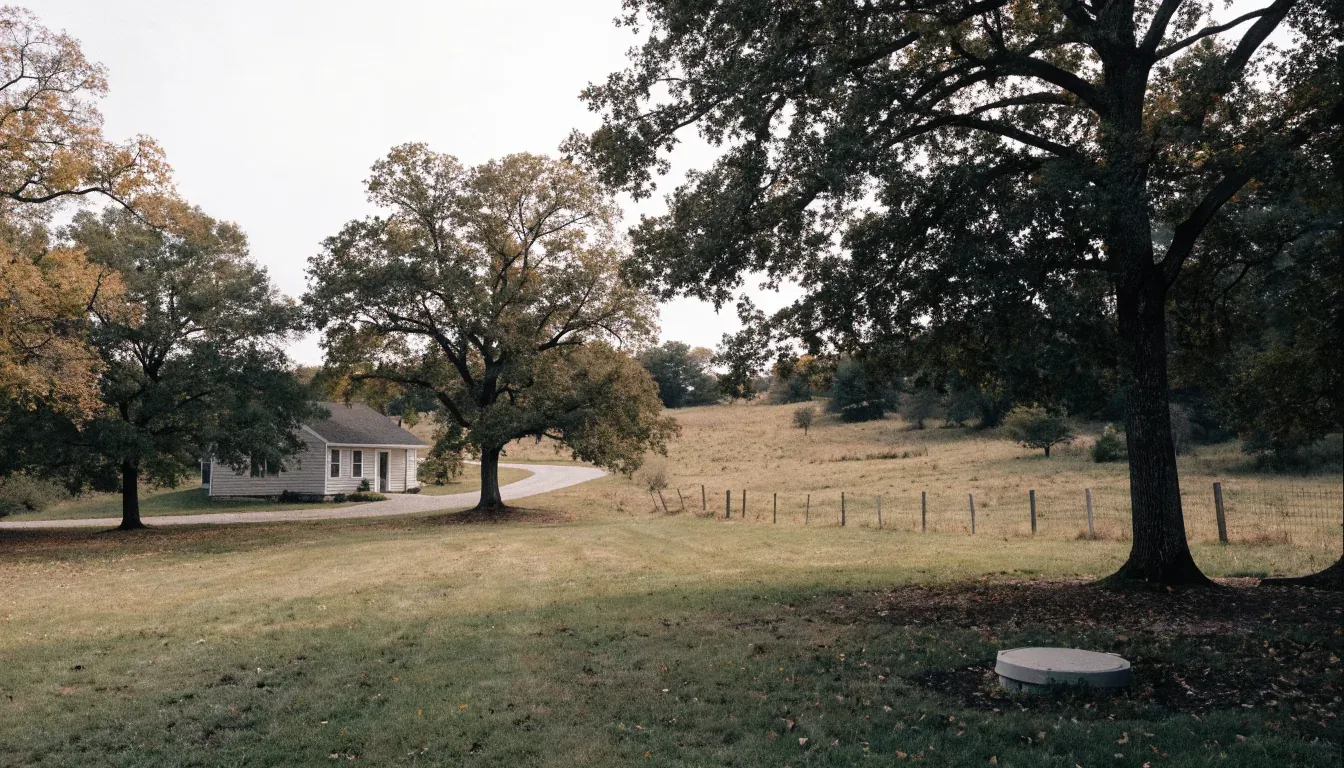

Septic service in Wildwood, Missouri
Wildwood is one city with two sewage answers running through it. MSD says its service area is bounded on the west by Highway 109, and Highway 109 runs through the middle of Wildwood, so the sewered majority and the unsewered west share a city hall. On the septic side the city adds a step almost nobody expects. Before St. Louis County ever sees the job, Wildwood wants the percolation test in hand, the septic field drawn on the plot plan, and the clearing limits drawn to include that field, with a tree preservation plan alongside it.
Who issues a septic permit in Wildwood, MO?
Wildwood being incorporated changes the order, not the office. The city issues the zoning authorization first, then St. Louis County, under contract with the city, runs plan review and inspections for the building permit, and the system permit itself is county business. Missouri's Department of Health and Senior Services lists the county plumbing office at (314) 615-0330 and the St. Louis County Department of Public Health at (314) 615-1600 as the ordinance authorities for onsite wastewater here, and says the county has its own onsite wastewater ordinance that may go past the state minimum standards.
St. Louis County Office of Plumbing and Sewer Inspection. Phone (314) 615-0330. Their page: St. Louis County Office of Plumbing and Sewer Inspection.
Is my Wildwood address on public sewer or on septic?
Highway 109 is the line. MSD Project Clear describes its service area as the land bordered by Highway 109 on the west, running to the Mississippi, Missouri and Meramec Rivers. That road runs through Wildwood, so one side of it is a sewer question and the other side a septic question. Ground west of the line is generally on individual systems or on small package treatment plants, several of which serve entire subdivisions.
The city has counted properties, not systems. A 2023 public works memorandum on a residential sewer lateral repair program puts about 11,900 properties in Wildwood, with about 22 percent of them west of State Route 109. That is a location split, not a septic count, and no source read for this page states how many Wildwood properties are on septic.
Checking your own address is quick. The city lists MSD as the sewer provider and Missouri American Water as the water provider, so read the bill first: a wastewater charge means you are inside the district. If it is unclear, call MSD with the address, then the city's Department of Planning at (636) 458-0440.
Who has to approve the septic design first in Wildwood?
The city, and earlier than most people expect. For new construction in the NU Non-Urban Residence District, Wildwood's zoning authorization guidelines ask for five copies of a percolation test where one applies, the location of the septic field shown on the plot plan, and clearing limits drawn to include all proposed structures, driveways or accesses, yard area, and the septic field. Only after the city issues the zoning authorization do four stamped copies of the building plans go to St. Louis County for the building permit, because the county administers plan review and inspection here under contract with the city.
So in Wildwood the septic field is a zoning question before it is a plumbing question. You cannot hand the city a house footprint and work out where the field goes later. The order of work inverts: soil and field location first, house siting second, county building permit third. A contractor used to unincorporated ground will not expect the city step, so say on the first call that Wildwood has one.
What does the tree preservation plan do to where a drainfield can go?
It puts the field in competition with the house for the same cleared ground. Wildwood's guidelines set a minimum tree canopy of 30 percent, stated in Ordinance No. 206, and require the clearing limits on the tree preservation plan to include the driveway, the home, the yard area and the septic field. Every square foot the drainfield needs, plus the room a machine needs to build it, comes out of the same clearing budget as everything else.
The envelope is tight before trees enter it. NU zoning now requires a minimum of three acres, with a 50-foot front yard setback measured from the edge of the right of way or private roadway easement and 30-foot side and rear yards. A wooded three-acre lot can look like plenty of room and still leave one workable field location once setbacks, slope and canopy are satisfied at once.
Walk the lot for field location before anything is cleared. Clearing first can spend canopy on ground the soil work later rejects.
Favor open or already thin ground for the field where the soil allows it, since that clearing spends the least canopy.
If the design carries a replacement area for a future field, get it on the same plot plan the city sees, along with the equipment access route.
What does the ground in Wildwood do to a septic design?
The city is blunt in its own Master Plan: the soils in much of the city are unsuitable for individual septic systems. It describes long steep hillsides, narrow convex summits, erodible soil surfaces, and slowly permeable and restrictive subsoil layers.
Slope and that restrictive subsoil layer, not rock, are the binding limit here. Nothing in the Master Plan read for this page raises sinkholes, karst or bedrock as a constraint on wastewater in Wildwood, and its one mention of limestone is historical, about a former limestone and stave industry. If you have read a Jefferson County page where rock and sinkholes drive the design, that is different ground. Here the two things that decide the design are the grade you are building on and how slowly water moves through the layer under the topsoil.
The same plan is skeptical of the perc test the city asks for, noting that results vary with how saturated the soil is and where on the property the test was made, and saying a soil morphology test, allowed under newer state law in place of the percolation analysis, is a better way to judge a location given the soils here. That is why soil morphology keeps coming up. In a 2022 Board of Adjustment finding for the Pond community, the city's Department of Planning recorded poor soils for percolation of effluent and a perched water table, and said what it wanted: a soil morphology report from a qualified soil scientist and an engineered design from a professional engineer, complying with State and St. Louis County regulations.
There is also a Wildwood answer for lots that will not take a system at all. The Master Plan describes small sewage treatment plants, called package plants, that can serve an entire residential subdivision, says several Wildwood subdivisions already have one, and notes they are inspected monthly by the Department of Natural Resources. The same finding for the Pond community says all wastewater treatment there is handled either by individual systems or by small packaged treatment plants. Before assuming a new tank and field, ask whether your subdivision already has a plant.
What does St. Louis County, MO require once the city is done?
The county is where the system permit itself lives. Missouri's Department of Health and Senior Services lists two St. Louis County offices holding ordinance authority for onsite wastewater: the plumbing and sewer inspection office at (314) 615-0330 and the St. Louis County Department of Public Health at (314) 615-1600. The same listing adds the line worth taking seriously, that the county runs its own onsite wastewater ordinance and may have requirements past the state minimum construction standards. The design standard you have to meet is county, not only state. Wildwood's Planning Department describes it the same way, as complying with State and St. Louis County regulations.
The county's own application, fee schedule and rules on who may lay drain could not be read at their source for this page, so none of them are stated here as fact, and this page makes no claim about whether the county requires a mechanical treatment unit rather than a conventional tank and field. Ask the plumbing office for the current design standard, forms and fees, and ask in the same call which of the two your lot takes, because that answer changes the drawing the city has to see.
Building permit questions go to a different desk. The city's own guidelines send those to the county Department of Public Works Permit Division at (314) 615-2559, with plans taken in Clayton at 41 South Central or at the Clarkson-Wilson Center satellite office. And if this is a new subdivision rather than one lot, the Department of Natural Resources has to approve the development where onsite systems are planned.
What should I have ready before calling a septic contractor?
An independent local septic contractor can work from this list, and all of it is information you already have or can request. The first two items are Wildwood specific rather than routine.
Which side of Highway 109 the address sits on, and whether an MSD wastewater charge appears on your bill.
The tree picture: what is wooded now, what would come down for a field and machine access, and any tree preservation plan from the original build.
A plot plan or survey showing property lines, the road right of way or private roadway easement, the well if there is one, and the existing tank and field if you can locate them.
Zoning and acreage. If the lot is NU, the three-acre minimum and the 50-foot front and 30-foot side and rear setbacks already shape the answer.
Any soil work already done, whether a percolation test or a soil morphology report.
Old permits and drawings for an existing system, plus the last pumping date.
If something is failing: backing up indoors, wet or surfacing ground over the field, odor, or a drain that slowed over months.
Where the facts on this page come from
- New construction in Wildwood's NU Non-Urban Residence District requires five copies of a percolation test where applicable, the location of the septic field on the plot plan, and clearing limits that include all proposed structures, driveways or accesses, yard area and the septic field. NU setbacks are 50 feet front, measured from the edge of right of way or private roadway easement, and 30 feet side and rear. The City of Wildwood Department of Planning is reached at (636) 458-0440. Source: City of Wildwood, Zoning Authorization Guidelines, New Construction WITHIN the NU (Non-Urban Residence District), read 2026-08-27.
- The City of Wildwood has contracted with St. Louis County to issue building permits and perform building inspections. Once the city issues the zoning authorization, four stamped copies of the building plans go to St. Louis County, at the Clayton offices at 41 South Central or the Clarkson-Wilson Center satellite office, and county submittal questions go to the St. Louis County Department of Public Works, Permit Division, at (314) 615-2559. Source: City of Wildwood, Zoning Authorization Guidelines, New Construction WITHIN the NU (Non-Urban Residence District), read 2026-08-27.
- The tree preservation plan's clearing limits must include the driveway, the home, the yard area and the septic field, against a minimum tree canopy of 30 percent stated in Ordinance No. 206. Source: City of Wildwood, Zoning Authorization Guidelines, New Construction WITHIN the NU (Non-Urban Residence District), read 2026-08-27.
- The soils in much of Wildwood are unsuitable for individual septic systems, percolation test results vary with soil saturation and where on the property the test was made, and newer state legislation allows a soil morphology test to substitute for the percolation analysis, which the plan calls a better means of judging a location given the city's soils. Source: City of Wildwood Master Plan, Environmental chapter, The Treatment of Sewage Effluent in This Environmentally Sensitive Area, read 2026-08-27.
- The city's alternative to individual septic systems in unserved areas is the small sewage treatment plant, or package plant, which can serve an entire residential subdivision. Several Wildwood subdivisions already have one, and package plants are inspected monthly by the Department of Natural Resources. Source: City of Wildwood Master Plan, Environmental chapter, The Treatment of Sewage Effluent in This Environmentally Sensitive Area, read 2026-08-27.
- Wildwood's terrain is long steep hillsides, narrow convex summits, erodible soil surfaces, and slowly permeable and restrictive subsoil layers, and development outside MSD boundaries is what raises the sewage treatment problem. No sinkhole, karst or bedrock constraint on wastewater appears anywhere in the 179-page plan; its single mention of limestone is historical, describing a former limestone and stave manufacturing industry. Source: City of Wildwood Master Plan, Environmental chapter, full document read and searched, read 2026-08-27.
- In the Pond community the city's Department of Planning recorded poor soils for percolation of effluent and a perched water table, and called for a soil morphology report from a qualified soil scientist plus an engineered design by a professional engineer, complying with State and St. Louis County regulations. The same finding states the Pond community is not served by public sanitary sewers, so all wastewater treatment there is provided on individual lots by individualized systems or small, packaged treatment plants. Source: City of Wildwood Department of Planning, Determination of Issues and Findings of Facts, Board of Adjustment Case B.A. #33-22, hearing of November 17, 2022, read 2026-08-27.
- The NU Non-Urban Residence District now requires a minimum of three acres. Source: City of Wildwood Department of Planning, Determination of Issues and Findings of Facts, B.A. #33-22, read 2026-08-27.
- MSD's service area is the land bordered by Highway 109 on the west, running to the Mississippi, Missouri and Meramec Rivers. Highway 109 runs through Wildwood. Source: MSD Project Clear (Metropolitan St. Louis Sewer District), About page, read 2026-08-27.
- The city lists Metropolitan Sewer District as the sewer provider and Missouri American Water as the water provider for Wildwood residents. Source: City of Wildwood, Utilities, Providers, State and County Government page, read 2026-08-27.
- A 2023 city memorandum on a residential sewer lateral repair program counts about 11,900 properties in Wildwood, with about 22 percent of them west of State Route 109. The memo does not state how many are on septic. Source: City of Wildwood, Memorandum from the Director of Public Works to the Administration and Public Works Committee, April 8, 2023, Residential Sewer Lateral Repair Program, read 2026-08-27.
- Missouri's Department of Health and Senior Services lists two St. Louis County agencies with ordinance authority for onsite wastewater permits: the county plumbing office at 41 S Central, (314) 615-0330, and the St. Louis County Department of Public Health at 6121 N. Hanley Rd, (314) 615-1600. The listing states this county has its own onsite wastewater ordinance and may have additional requirements beyond the state minimum construction standards. Source: Missouri Department of Health and Senior Services, OWTS Construction Permit Required, county listing filtered to St. Louis (county), read 2026-08-27.
- The Department of Natural Resources must approve subdivisions, mobile home parks and campgrounds where the use of onsite wastewater treatment systems is planned. Source: Missouri Department of Health and Senior Services, OWTS Construction Permit Required, Additional Information, read 2026-08-27.
- Some Missouri cities are incorporated and may not fall under the local permitting authority even where an ordinance is in place. Where work is inside one of those incorporated areas, the local permitting authority defers the permit process back to the Department of Health and Senior Services. Source: Missouri Department of Health and Senior Services, OWTS Construction Permit Required, read 2026-08-27.
Three things are not settled here. St. Louis County's own septic application, fee schedule and drainlayer rules sit behind a block that refused every attempt, so nothing about county forms or fees is stated as fact, and no source read for this page confirms that the county requires a mechanical treatment plant rather than a conventional tank and field on a single lot, so this page does not say it does. Ask the plumbing office at (314) 615-0330. Missouri's health department says incorporated cities may be deferred back to the state for permitting; Wildwood's own documents point to St. Louis County and that is the practical answer, but the deferral question was not confirmed for Wildwood specifically. And no source states how many Wildwood properties are on septic rather than sewer, so no such percentage appears above.
Related
- St. Louis County, MO septic permits and requirements
- Septic in the St. Louis metro
- Septic design and soil evaluation
- Septic system installation
- Drainfield replacement
- Soil evaluation and perc test, what the report has to show
- Find the records for an existing system
- The Missouri septic permit, start to finish
- What to do with a failing system
Get a free quote from a septic contractor near Wildwood
Tell us the county and the job. No email needed.
A marketing service, not a licensed contractor. Septic work is performed by independent local contractors.
Need the job done, not just the rule explained
Your request goes straight to an independent local septic contractor serving your Missouri county, usually within about an hour during the day, not a national lead list.
Tell us the county and the jobLast reviewed 2026-08-27.