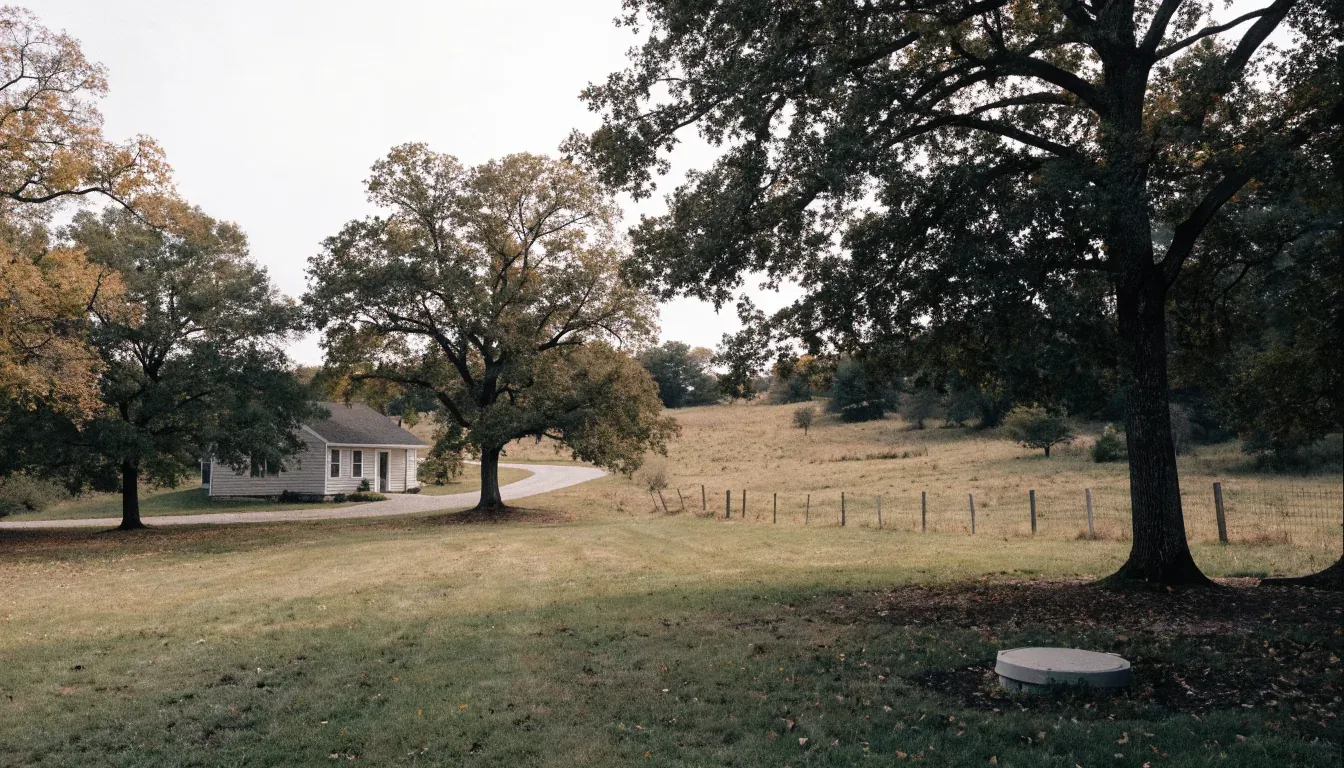

Septic installation and replacement in St. Louis County, Missouri
St. Louis County is the one county in this metro where a plain septic tank and lateral field is not the standard design. The county plumbing code requires that all water-carried sanitary sewage pass through a mechanical treatment plant before it reaches the soil. That plant has to be tested and approved by the National Sanitation Foundation and carry the NSF Standard 40 Class I treatment listing, it has to wear an NSF approval emblem the inspector can see on the equipment, and the manufacturer or distributor has to show that repair parts and a service company are available, so what can be installed here is limited to what somebody can service here. An engineer sizes the plant, never below the manufacturer's specifications and never below 120 gallons per bedroom per day or 1,000 gallons, whichever is greater, and access to it has to be brought within 14 inches of finished grade. The second surprise is the office. The septic rules sit in the county plumbing code rather than in health regulations, and the office that enforces them, the Office of Plumbing and Sewer Inspection, was created inside the Department of Public Works. Most of the county is not septic country at all, because it sits inside the Metropolitan St. Louis Sewer District and a public sewer close enough to the property ends the question; the St. Louis metro guide carries that boundary and the connection rules. Septic country here is the western and southern end, out around Wildwood, Glencoe, Grover and the Meramec valley. On permits, state law is the floor rather than the whole story. Section 701.046 of the Revised Statutes of Missouri requires a construction permit before a new system, a septic tank replacement or a new absorption field, but it opens "Except as otherwise provided in section 701.031", and section 701.031 excludes the owner of a single-family residence lot of three acres or more, and a residential lot of 10 acres or more that meets a separation and density test, from sections 701.025 to 701.059 and the rules under them. The conditions are strict: every point of the system more than 10 feet from any adjoining property line, no effluent onto an adjoining property or into surface water or groundwater, no nuisance, and the exclusion does not reach lots adjacent to lakes operated by the Corps of Engineers or by a public utility. A county may still regulate under its own ordinance, and St. Louis County does exactly that. The county plumbing code applies here, the county approval and design have to be on file before a building permit is issued, and where the Code Official finds the lot area insufficient or the soils improper, no onsite system is permitted at all. Plan on a county permit and a state-registered installer for your lot, and call the office before planning around any exclusion.
Who issues a septic permit in St. Louis County, MO?
The St. Louis County Department of Transportation and Public Works, Office of Plumbing and Sewer Inspection. That is the office to call before anything else, because in Missouri the permitting authority is not the same kind of agency in every county, and assuming it is the health department wastes a week in the counties where it is not.
Phone (314) 615-0330. Their page: St. Louis County Department of Transportation and Public Works, Office of Plumbing and Sewer Inspection.
Source: Missouri Department of Health and Senior Services, onsite wastewater construction permit authority lookup for St. Louis County, read 2026-09-12. Fees, forms and requirements change, and this county is the only current source for its own.
What does St. Louis County require beyond the state standard?
- The county's septic rules are not health department rules. They sit in the county plumbing code, Chapter 1103, which adopts and amends Chapter 22 of the Uniform Plumbing Code for homes and other buildings where a public sewage system is not available, and the office charged with enforcing that code, the Office of Plumbing and Sewer Inspection, was created inside the Department of Public Works. Source: St. Louis County Revised Ordinances, Chapter 1103 (Plumbing Code), Sections 1103.P-122 and 1103.415, read 2026-08-27.
- Every individual system in St. Louis County needs a mechanical treatment plant. All water-carried sanitary sewage must pass through an approved mechanical sanitary sewage treatment plant before it is discharged into the soil, and the code defines the system as that plant discharging into an approved subsurface disposal field. This is the largest single departure from the Missouri state minimum standard. Source: St. Louis County Revised Ordinances, Chapter 1103, adopted Uniform Plumbing Code Chapter 22, Sections 22.1.7 and 22.3.4, read 2026-08-27.
- The plant must be tested and approved by the National Sanitation Foundation and meet the NSF Standard 40 Class I treatment listing, and it must carry an NSF approval emblem on the equipment so the inspector can see it. The manufacturer or distributor also has to show that repair parts and a qualified service company are available, so what can be installed here is limited by what somebody can service here. Source: St. Louis County Revised Ordinances, Chapter 1103, adopted Uniform Plumbing Code Chapter 22, Sections 22.3.8.2 to 22.3.8.4, read 2026-08-27.
- The plant is sized by an engineer, and never below the manufacturer's specifications or below 120 gallons per bedroom per day or 1,000 gallons, whichever is greater. Design flow for a single-family dwelling is the same 120 gallons per bedroom per day, with 50 gallons per person added above two persons per bedroom, and access to the plant has to be brought within 14 inches of finished grade. Source: St. Louis County Revised Ordinances, Chapter 1103, adopted Uniform Plumbing Code Chapter 22, Sections 22.9.3 and 22.9.4 and Table 22.3.7, read 2026-08-27.
- Minimum lot size for an individual system is 20,000 square feet where the premises are served by a public water main, and 30,000 square feet where they are not. Source: St. Louis County Revised Ordinances, Chapter 1103, adopted Uniform Plumbing Code Chapter 22, Section 22.4.1, read 2026-08-27.
- Every building in which plumbing fixtures are installed, and every premise with drainage piping, must connect to a public sewer if available, and the code deems a sanitary sewer available when the line is within 200 feet of any part of the property to be connected. The metro guide at /st-louis-septic/ carries this rule and the sewer boundary in full. Source: St. Louis County Revised Ordinances, Chapter 610 (Sewage and Waste Disposal), Section 610.080, read 2026-08-27.
- Most of the county is not septic country at all. The Metropolitan St. Louis Sewer District describes its service area as all of St. Louis City and 90 percent of St. Louis County, with Highway 109 as the general western boundary and the Missouri, Mississippi and Meramec rivers as the others. Septic is what lies west and south of that line, plus any parcel that sits too far from a sewer. The metro guide at /st-louis-septic/ carries the boundary story in full. Source: Metropolitan St. Louis Sewer District (MSD Project Clear), glossary entry for Service Area, read 2026-08-27.
- The county setback table carries a sinkhole line: 50 feet from a sewage tank to the edge of a surficial sinkhole and 100 feet from the disposal area, with a note that sewage tanks and soil absorption systems should never be located in the drainage area of a sinkhole. The code separately bans discharging sewage or effluent into any abandoned or unused well, or into any crevice, sinkhole or other opening in a rock formation. Source: St. Louis County Revised Ordinances, Chapter 1103, adopted Uniform Plumbing Code Chapter 22, Table 22.4.3 and note 4, and Section 22.1.5, read 2026-08-27.
- Percolation results decide how far the project has to go. Above 45 minutes per inch the engineer must run at least two more test holes elsewhere on the site, and if those also exceed 45 minutes per inch the engineer has to design an alternate system with the plumbing official's approval. Where the average rate is above 120 minutes per inch, or severe geological limitations exist, a qualified soil scientist or engineer must perform a soil morphology evaluation, and above 150 minutes per inch that evaluation has to be detailed enough to justify the design. Source: St. Louis County Revised Ordinances, Chapter 1103, adopted Uniform Plumbing Code Chapter 22, Sections 22.5.10, 22.4.4.5 and 22.5.7, read 2026-08-27.
- The septic approval gates the building permit. After the application, a county field survey is done on site with the property owner or a representative present to sign the field survey checklist, and that checklist, the site plan with the treatment design and all percolation or soil morphology data must be approved and on file with the Office of Plumbing and Sewer Inspection before the building permit is issued. Where the Code Official finds the lot area insufficient, the soil conditions improper or the lot grades wrong, no building permit is issued and no onsite system is permitted. Source: St. Louis County Revised Ordinances, Chapter 1103, adopted Uniform Plumbing Code Chapter 22, Section 22.9 (Code Official field survey checklist) and Section 22.2, read 2026-08-27.
- The percolation testing itself is supervised. Four test holes go in at separate locations spread over the site, usually 50 feet apart in a square pattern, plus a six-foot test bore in the proposed drain field. The engineer gives the county 24 hours notice and a county representative attends, and the holes cannot be backfilled until the field is installed and approved. Source: St. Louis County Revised Ordinances, Chapter 1103, adopted Uniform Plumbing Code Chapter 22, Sections 22.5.1 and 22.5.10, read 2026-08-27.
- The county publishes the permit fee in its own fee schedule: the minimum fee to install a septic system is $284.00, made up of a $96.00 permit processing and plan review fee plus $188.00 for up to four inspections. Each additional inspection is $47.00, and an inspection running over one hour including travel time adds $24.00 for each additional half hour. Source: St. Louis County Revised Ordinances, Chapter 1100 (Code Enforcement Fee Schedules), Section 1100.200, as amended by Ordinance No. 29445 on November 5, 2025, read 2026-08-27.
- A construction permit is the rule, and the statute that sets it names its own exception. No person may construct or make a major modification or major repair to an onsite sewage disposal system without first notifying the city, county or department, completing an application on the department's form, paying the fee set by that city, county or department, and obtaining a construction permit. The section opens "Except as otherwise provided in section 701.031". Missouri separately defines a major modification or major repair as relocation of the system or a part of it, replacement of the septic tank, or construction of a new absorption field, which is what pulls a tank replacement or a new lateral field into permitted work. Source: Section 701.046, Revised Statutes of Missouri, read 2026-08-26.
- The large-lot exclusion, verified at the statute. The owner of a single-family residence lot of three acres or more, or of a residential lot of ten acres or more with no single-family residence onsite sewage disposal system within three hundred sixty feet of any other one and no more than one single-family residence per ten acres in the aggregate, is excluded from sections 701.025 to 701.059 and the rules made under them, including the provisions on construction, operation, major modification and major repair. The exclusion does not reach lots adjacent to lakes operated by the Corps of Engineers or by a public utility, and it applies only when all points of the system sit more than ten feet from any adjoining property line and no effluent enters an adjoining property, contaminates surface water or groundwater, or creates a nuisance as determined by a readily available scientific method. The same section also provides that any person installing onsite sewage disposal systems shall be registered to do so by the Department of Health and Senior Services. A county that regulates under its own ordinance, as St. Louis County does through its plumbing code, still applies that ordinance to the lot. Source: Section 701.031, Revised Statutes of Missouri, read 2026-08-26.
- The bedrock under the St. Louis 30 by 60 minute quadrangle, which contains St. Louis County, is Paleozoic sedimentary rock, and the Mississippian limestones mapped in the area include the Burlington and Keokuk, Salem and St. Louis Limestones. The report states that bedrock is poorly exposed throughout the extensively urbanized quadrangle, that much of the area is covered by Quaternary loess, glacial till, residuum and fluvial deposits, and that exposures of bedrock are in river bluffs, road cuts and quarries. Source: U.S. Geological Survey Map I-2533, "Bedrock Geologic Map of the St. Louis 30 by 60 minute Quadrangle, Missouri and Illinois", compiled by Richard W. Harrison, 1997, pamphlet to accompany the map, read 2026-08-27.
- The state describes the karst setting and the risk in its own words. Sinkholes are depressed or collapsed areas formed by dissolution of carbonate bedrock or collapse of underlying caves, and "Sinkholes are part of what is called karst topography, which also includes caves, springs and losing streams." Much of the state is underlain by carbonate bedrock that has the potential for karst development: water moving through cracks in limestone and dolomite slowly dissolves the rock, the soil above washes into the void, and sinkholes form at the surface. The department warns that sinkholes often serve as direct conduits for rapid surface water infiltration into the underlying groundwater aquifer, and that contaminants near or at the surface can quickly enter the aquifer and pollute drinking water. About 16,000 sinkholes have been identified in Missouri, and many more exist that have not been reported or documented. Source: Missouri Department of Natural Resources, Missouri Geological Survey, Sinkholes, read 2026-08-27.
Missouri lets a county adopt standards more restrictive than the state's, so a requirement here is not evidence of the same requirement one county over.
Source: Missouri Department of Health and Senior Services, Onsite Wastewater Treatment, read 2026-09-12.
What is the ground like in St. Louis County?
Western St. Louis County sits on Paleozoic sedimentary rock, with Mississippian limestone among the units mapped here, under a patchy Quaternary cover of loess, glacial till, residuum and fluvial deposits. The USGS map of this quadrangle records that bedrock is poorly exposed across the urbanized area and is exposed mainly in river bluffs, road cuts and quarries, which is the Meramec valley setting where most of the county's septic work happens. Carbonate rock this close to the surface makes it karst ground. In the state's own words, sinkholes are part of what is called karst topography, which also includes caves, springs and losing streams, and they form where water moving through cracks in limestone and dolomite dissolves the rock and the soil above washes into the void. The state's warning is the one that decides a septic design here: sinkholes often serve as direct conduits for rapid surface water infiltration into the underlying groundwater aquifer, so contaminants at or near the surface can reach drinking water quickly. The county code reads like it was written for that. There is a setback from the edge of a sinkhole, a note that a tank or a field should never sit in a sinkhole's drainage area, and a flat ban on putting sewage into a crevice or a sinkhole. The design consequences run in both directions. Thin soil over fractured rock can move water faster than the soil can treat it, and heavy clay moves it too slowly, which is why the county stops trusting a percolation number at the slow end and sends a soil scientist out instead. Past 45 minutes per inch more test holes go in, and if they read the same the design moves to an alternate system. Past 120 minutes per inch a soil morphology evaluation is required. On a lot here, depth to rock and the location of the nearest sinkhole often decide where a field can go, or whether one can go at all, before the house plan is settled.
That matters because the soil decides the system. A standard system needs at least one foot between the trench bottom and the limiting layer or seasonal high water table, rising to four feet to groundwater or bedrock in highly permeable soils and in cherty clay soils in areas of severe geological limitations, and a percolation rate slower than sixty minutes per inch pulls a registered engineer onto the design.
The soil evaluation is what settles it for your particular lot.
Source: 19 CSR 20-3.060(5)(A)2., Missouri Code of State Regulations, read 2026-09-12.
Which towns does this cover?
St. Louis County has Clayton as its county seat. Places served include Wildwood, Glencoe, Grover, Pond, Melrose, Fox Creek, Sherman. Anywhere in the county not on a public sewer is on a system this page applies to.
Who is allowed to do the work here?
An installer registered with the Missouri Department of Health and Senior Services. That is a state requirement rather than a county one. The statute carrying it also carries a large-lot exclusion for some single-family lots of three acres or more, on strict conditions, and a county regulating under its own ordinance can require its own permit and its own registration regardless, which is what the collar counties around St. Louis do. Some counties add their own licensing on top of the state registration, which is one more reason to ask the permitting authority what they require before you sign anything.
Who is allowed to do the work covers what registration means here.
Source: Section 701.031, Revised Statutes of Missouri, read 2026-09-12.
What we could not confirm for this county
The county's own website could not be read. Every request to the county site returned a bot challenge page, so the Application for Individual Sewage Disposal, any county submittal checklist and the current published fee sheet were never seen. Everything above comes from the county's Code of Ordinances as published by its official codifier, current through Ordinance No. 29,532 of February 17, 2026, from the Revised Statutes of Missouri, from the USGS and Missouri DNR sources cited, and from the Missouri DHSS county authority lookup. That is the law rather than the counter procedure, so call before filling anything out: the plumbing office at (314) 615-0330, and the county Department of Public Health at (314) 615-1600, which can hold a plumbing permit until it signs off. Three open points. No single sentence in the code says which of the two offices stamps the onsite permit, so the plumbing office is named here because the septic rules sit in the plumbing code and the enforcing office sits in Public Works. No general point-of-sale septic inspection was found anywhere in the county code, but the health commissioner's own rules are not printed in the code and were not read, so treat that as unconfirmed rather than as a no. And the state large-lot exclusion in section 701.031 was read at the statute, but nothing in the county code was found that adopts or waives it, so do not assume a three-acre lot escapes the county plumbing code: the county requirement is the one to confirm by phone. Requirements inside incorporated cities such as Wildwood may add a step the county code does not show.
Get a free quote from a septic contractor in St. Louis County
Tell us the county and the job. No email needed.
A marketing service, not a licensed contractor. Septic work is performed by independent local contractors.
Need the job done, not just the rule explained
Your request goes straight to an independent local septic contractor serving your Missouri county, usually within about an hour during the day, not a national lead list.
Tell us the county and the jobLast reviewed 2026-09-12.