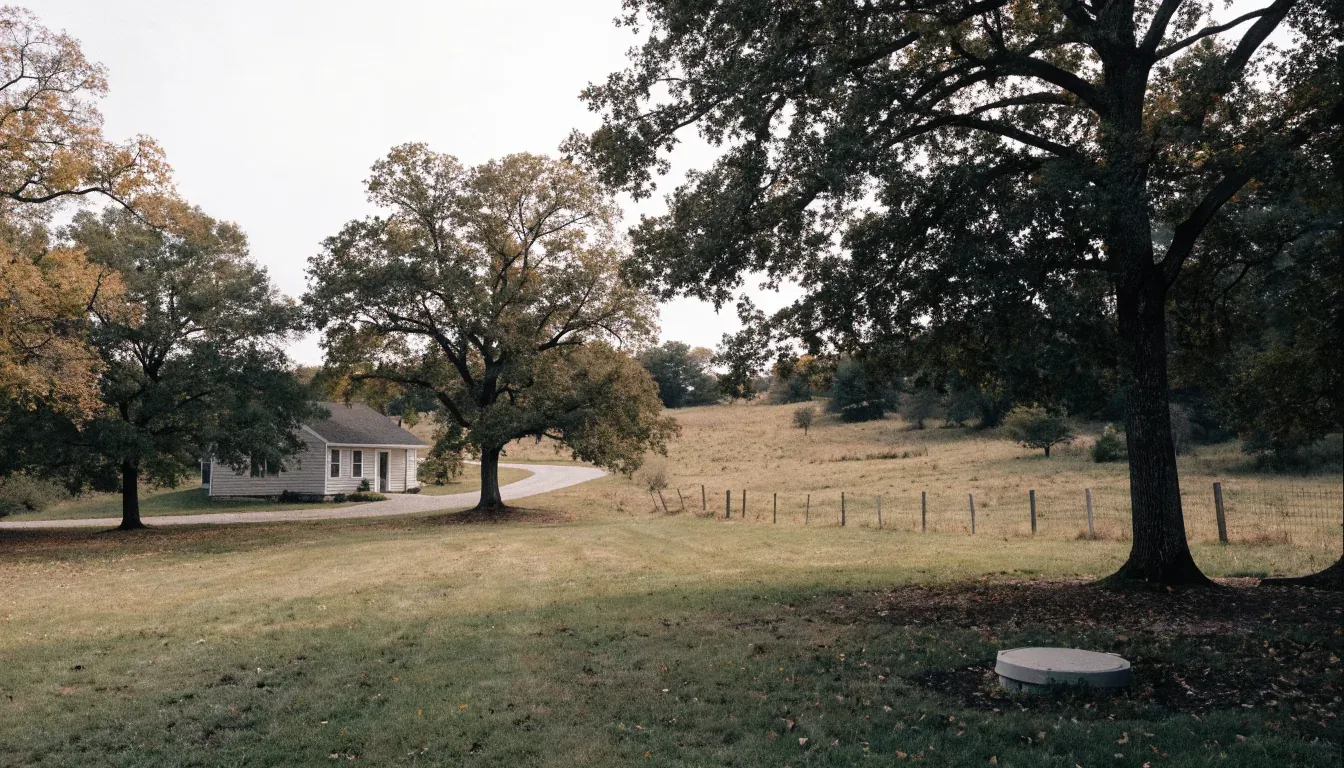

Septic tank installation in the St. Louis, Missouri metro
Installation here is a sequence, and the order never changes: soil evaluation, a design the soil will take, the permit, then machines. What changes across a county line is what the design must be and who signs off. The hard news first: in St. Louis County, MO a plain tank and field is not the standard design, because county code requires a mechanical treatment plant on every system. In St. Charles County, MO the deciding number is three acres, and and the county publishes no exception to it.
What has to happen before anyone digs?
Six steps, always in this order. Skip one and the job stalls at the county counter, after money has been spent.
Start with whether a state permit is even in play, because the statute is not absolute. Section 701.046 opens "Except as otherwise provided in section 701.031", and 701.031 excludes the owner of a single-family residence lot of three acres or more, and of a residential lot of 10 acres or more meeting a separation and density test, from sections 701.025 to 701.059 and the rules made under them. The conditions are strict: every point of the system more than 10 feet from any adjoining property line, and no effluent onto adjoining property, into surface water or into groundwater, and no nuisance. The exclusion does not reach lots adjacent to lakes operated by the Corps of Engineers or by a public utility.
What the exclusion does not do is switch off a county. The collar counties in this metro permit under their own ordinances, and a local ordinance can be stricter than the state standard, so on a metro lot plan on a permit whatever the acreage and confirm with the permitting office before planning around the exclusion. Replacing a septic tank or building a new absorption field is a major repair in state terms, which is what pulls this work into the permit system in the first place.
The St. Louis County gate sits earlier than people expect. The field survey checklist, the site plan and all soil data must be on file and approved with the county before the building permit issues.
Inspections are sequential. Nothing passes an inspection point without written approval, and work covered before testing can be ordered re-exposed. The minimum septic fee is $284.00: $96.00 for plan review plus $188.00 for up to four inspections, then $47.00 each.
Find out who permits your exact address, and do not assume it is a health department. In this metro it is often a plumbing, code enforcement or building office instead. The full who-permits-where roundup is on the metro hub page at /st-louis-septic/.
Get the soil evaluated on the ground itself: percolation testing, soil morphology, or both.
Have a design drawn that the soil will take, sealed by an engineer where the county or the state rule requires a seal.
Apply for the permit and clear the field survey and site plan review.
Install, with the tank, the trench excavation and the field inspected in stages.
Pass the final inspection, and properly abandon any old system: disconnected, pumped out, tank bottom broken out, backfilled.
Section 701.046 opens "Except as otherwise provided in section 701.031", and then requires that no person construct or make a major modification or major repair to an onsite sewage disposal system without first notifying the city, county or department, completing an application, paying the fee set by that city, county or department, and obtaining a construction permit. Source: Section 701.046, Revised Statutes of Missouri, read 2026-08-26.
The owner of a single-family residence lot of three acres or more, or of a residential lot of ten acres or more with no single-family residence onsite sewage disposal system within three hundred sixty feet of any other one and no more than one single-family residence per ten acres in the aggregate, is excluded from sections 701.025 to 701.059 and the rules made under them, including the provisions on construction, operation, major modification and major repair. The exclusion does not reach lots adjacent to lakes operated by the Corps of Engineers or by a public utility, and it applies only when all points of the system sit more than ten feet from any adjoining property line and no effluent enters an adjoining property, contaminates surface water or groundwater, or creates a nuisance as determined by a readily available scientific method. Source: Section 701.031, Revised Statutes of Missouri, read 2026-08-26.
Missouri defines a major modification or major repair as the redesigning and alteration of an onsite sewage system by relocation of the system or a part of it, replacement of the septic tank, or construction of a new absorption field. Source: Section 701.025(6), Revised Statutes of Missouri, read 2026-08-26.
Where the permitting authority rests on a local ordinance, the local regulation can be more restrictive than the state standard, so the local authority is the one to check. Source: Missouri DHSS, Onsite Wastewater Treatment, read 2026-08-26.
In most Missouri counties the local health department issues the onsite wastewater construction permit. In the other counties the authority is another agency, such as a sewer district, building department, or planning and zoning department. Source: Missouri DHSS, Onsite Wastewater Treatment, read 2026-08-26.
The Field Survey Check List, the site plans with sewage treatment design, and all percolation or soil morphology data must be approved by the Code Official and on file with the Office of Plumbing and Sewer Inspections before the building permit is issued, and the owner or their representative must attend the field survey. Source: St. Louis County Revised Ordinances, Chapter 1103, adopted Uniform Plumbing Code Chapter 22, Section 22.9, read 2026-08-27.
No work may proceed past an inspection point without written approval, a final inspection is required before occupancy, and work covered before testing may be ordered exposed again. Source: St. Louis County Revised Ordinances, Section 1103.P-138, read 2026-08-27.
The minimum fee to install a septic system in St. Louis County is $284.00, made up of a $96.00 permit processing and plan review fee plus $188.00 for up to four inspections. Each additional inspection is $47.00. Source: St. Louis County Revised Ordinances, Chapter 1100, Section 1100.200, read 2026-08-27.
Abandoned individual sewage disposal systems must be disconnected from the building, pumped out with the contents properly disposed of, the tank bottom broken out, and the tank backfilled with crushed limestone, gravel or clean compacted dirt. Source: St. Louis County Revised Ordinances, Chapter 1103, adopted Uniform Plumbing Code Chapter 22, Section 22.1.9, read 2026-08-27.
Why does the soil evaluation decide both the price and the possibility?
It answers two questions, and either can end a project: how fast water moves through this soil, and how far down sits the first layer that stops it. Everything else follows.
St. Louis County spells the procedure out. Four test holes go in separate locations across the site, usually 50 feet apart in a square pattern, plus a six-foot bore in the proposed drain field. Nothing is backfilled until the field is approved.
The number buys field size. In St. Louis County, two to 15 minutes per inch requires 200 square feet of absorption area per bedroom, 15 to 30 requires 250, 30 to 45 requires 300. Above 45 the code calls for an alternate system instead. No field is ever under 400 square feet.
Two neighboring counties will not size a design off percolation at all. St. Charles County struck the perc test sections out of its adopted code, so design runs off soil morphology, a described soil profile. Lincoln County requires a morphology evaluation from a qualified Missouri soil scientist. University of Missouri Extension gives the reason: it treats percolation results as usable for design only between 10 and 60 minutes per inch, and Missouri soils often fall outside that window in both directions.
Percolation testing in St. Louis County requires four test holes in separate locations spread over the site, usually 50 feet apart in a square pattern, plus a six-foot test bore in the proposed drain field. The engineer must give 24 hours notice, the county may attend, the holes are flagged, and they are not backfilled until the field is installed and approved. Source: St. Louis County Revised Ordinances, Chapter 1103, adopted Uniform Plumbing Code Chapter 22, Sections 22.5.1 and 22.5.10, read 2026-08-27.
Absorption field sizing in St. Louis County: two to 15 minutes per inch, 200 square feet per bedroom; 15 to 30, 250 square feet; 30 to 45, 300 square feet; over 45, an alternate system is to be considered. In no case is less than 400 square feet of absorption area provided. Source: St. Louis County Revised Ordinances, Chapter 1103, adopted Uniform Plumbing Code Chapter 22, Sections 22.6.1 and 22.6.2, read 2026-08-27.
St. Charles County deleted Sections 404.2.1 to 404.2.4, the percolation test sections, from the private sewage disposal code it adopted, so design there runs off a described soil profile rather than a percolation rate. Source: St. Charles County, 2021 Private Sewage Disposal Code amendments, read 2026-08-26.
Lincoln County requires the owner or their agent to obtain a soil morphology evaluation from a qualified Missouri soil scientist. A percolation test alone will not carry an application. Source: Lincoln County Health Department, onsite application packet, step 3, read 2026-08-26.
Percolation results are only accepted for design purposes if the rates are between 10 and 60 minutes per inch. Outside that range a soil morphology evaluation must be used to size the absorption field. Source: University of Missouri Extension, publication EQ 401, Septic Tank/Absorption Field Systems, read 2026-08-27.
Percolation tests are to be conducted by an engineer, sanitarian, registered geologist, soil scientist, or a person trained and certified by the department. A soil morphology evaluation is to be conducted by a soil scientist, unless an engineer, registered geologist or sanitarian has had special training and field experience. Where soil morphology is used, no percolation test is required, though the administrative authority may still ask for one. Source: 19 CSR 20-3.060(2)(D)1. and 2., Missouri Code of State Regulations, read 2026-08-26.
What does each county require of the design?
What follows is only the design requirement each county imposes. Who issues the permit, who licenses the trade and what a sale triggers sit on the metro hub page and on the county pages.
A city layer sits on top. Wildwood requires large-lot single-family subdivisions without public sanitary sewer to install packaged wastewater treatment plants, and using individual household systems instead takes a waiver.
St. Louis County, MO. Not a plain tank and gravity field: all water-carried sewage must pass through an approved mechanical treatment plant before it reaches an approved sub-surface disposal field, and the plant is sized by an engineer. The equipment standard, sizing numbers and access rules are set out on /st-louis-septic/aerator-and-pump-replacement/. Minimum lot: 20,000 square feet on public water, 30,000 without.
St. Charles County, MO. A minimum of three acres is required for a new system. Design runs off soil morphology, not percolation. Tank and field both sit 30 feet off any property line, against 10 feet in the state table. No new lagoons, and no surfacing of sewage.
Jefferson County, MO. Under the county's own On-Site Sewage Treatment Code, Chapter 705, a new home needs a soil morphology report with four sample pages, and the application takes three full sets of sealed plans and soils reports.
Franklin County, MO. The rulebook is recent: the county's On-Site Sewage Disposal Systems Ordinance was adopted and amended September 23, 2025, effective October 1, 2025. A design drawn to older advice is worth re-checking.
Lincoln County, MO. Design runs off a soil morphology evaluation by a qualified Missouri soil scientist. A percolation test alone will not carry an application.
All water-carried sanitary sewage in St. Louis County must pass through an approved mechanical sanitary sewage treatment plant before discharging into the soil, and the individual system consists of that plant discharging into an approved sub-surface disposal field. Source: St. Louis County Revised Ordinances, Chapter 1103, adopted Uniform Plumbing Code Chapter 22, Sections 22.1.7 and 22.3.4, read 2026-08-27.
The mechanical treatment plant must be sized by an engineer. Source: St. Louis County Revised Ordinances, Chapter 1103, adopted Uniform Plumbing Code Chapter 22, Section 22.9.3, read 2026-08-27.
Minimum lot size for an individual system in St. Louis County is 20,000 square feet where the premises are served by a public water main, and 30,000 square feet where they are not. Source: St. Louis County Revised Ordinances, Chapter 1103, adopted Uniform Plumbing Code Chapter 22, Section 22.4.1, read 2026-08-27.
A minimum of three acres is required for the installation of a new onsite wastewater treatment system in St. Charles County. The county does not allow new lagoons and does not allow surfacing of sewage regardless of property ownership. Source: St. Charles County, Onsite Wastewater Treatment Systems FAQ, read 2026-08-26.
St. Charles County deleted Sections 404.2.1 to 404.2.4, the percolation test sections, from the private sewage disposal code it adopted, so design there runs off a described soil profile rather than a percolation rate. Source: St. Charles County, 2021 Private Sewage Disposal Code amendments, read 2026-08-26.
St. Charles County requires a sewage tank 100 feet from any private water supply for new construction, and both sewage tanks and absorption fields 30 feet from any property line, against 10 feet in the state table. Source: St. Charles County, 2021 Private Sewage Disposal Code amendments to Section 802, read 2026-08-26.
Jefferson County has adopted its own On-Site Sewage Treatment Code, Chapter 705, which governs onsite sewage design and installation in the county. Source: Jefferson County, Codes and Ordinances, read 2026-08-26.
A Jefferson County application takes three full sets of sealed plans and soils reports, a new home requires a soil morphology report with four sample pages, and a final inspection must be completed on every permit. Source: Jefferson County, On-Site Sewage Treatment System Permit Application, read 2026-08-26.
Franklin County adopted and amended its On-Site Sewage Disposal Systems Ordinance and Regulations on September 23, 2025, with an effective date of October 1, 2025. Source: Franklin County Building Department, read 2026-08-26.
Lincoln County requires the owner or their agent to obtain a soil morphology evaluation from a qualified Missouri soil scientist. A percolation test alone will not carry an application. Source: Lincoln County Health Department, onsite application packet, step 3, read 2026-08-26.
Wildwood requires large-lot single-family subdivisions in areas not currently served by public sanitary sewers to install packaged wastewater treatment plants, and a developer seeking to use individual household systems instead must request a waiver. The city also issues its own zoning authorizations for septic systems. Source: City of Wildwood, Department of Planning report to the City Council, March 25, 2026, read 2026-08-27.
What percolation rate or bedrock depth pushes the job to an engineer?
In St. Louis County an engineer is in the job from day one: the site plan carries an original engineer seal and signature, and the treatment plant is sized by an engineer. Statewide, the rule brings an engineer in when percolation runs slower than 60 minutes per inch, unless a soil evaluation has already established site suitability and sizing.
Both ends of the scale are a problem. Slow soil cannot absorb the effluent. Fast soil does not treat it, because in fractured carbonate ground water can reach the aquifer before the soil has done its job.
Depth to rock is the other decider, and western St. Louis County is limestone country under a cover of loess, glacial till and residuum. Missouri DNR states that sinkholes, also called dolines, are depressed or collapsed areas formed by dissolution of carbonate bedrock or collapse of underlying caves, and that they often act as direct conduits carrying surface water into the aquifer. County code answers that ground: 50 feet from a surficial sinkhole edge for the tank, 100 feet for the field, and never in a sinkhole's drainage area.
Slower than 60 minutes per inch, statewide: the design must be drafted and signed by a registered engineer, unless a soil evaluation established suitability and sizing. The rule says absorption trenches should not be constructed in soils slower than 60 minutes per inch, and in no case shall they be constructed in soils slower than 120 minutes per inch.
Over 45 minutes per inch in St. Louis County: at least two more test holes at another suitable field location. If those also exceed 45, the engineer designs an alternate system with the plumbing official's approval.
Average over 120 minutes per inch, or severe geological limitations: a morphology evaluation by a qualified soil scientist or engineer.
Very fast soil, and here the two rulebooks do not line up. The St. Louis County sizing table starts at two minutes per inch, while University of Missouri Extension treats percolation results as usable for design only between 10 and 60 minutes per inch, so on faster ground expect the reviewer to want a soil morphology evaluation rather than a rate. Where morphology is used the state rule asks for no percolation test, though the authority may still request one. Ask the permitting office which it will accept before paying for testing.
Rock or hardpan shallower than four feet, or a water table within four feet of grade during any prolonged period: the Code Official decides whether an absorption field is appropriate at all, and how big.
The engineer's site plan must show all existing potable water wells or cisterns on adjacent properties within 75 feet of the property line, contours at two-foot intervals in the proposed drain field area including adjacent areas within 25 feet, and an original engineer seal and signature on all documents. Source: St. Louis County Revised Ordinances, Chapter 1103, adopted Uniform Plumbing Code Chapter 22, Section 22.5.10 site plan requirements, read 2026-08-27.
The mechanical treatment plant must be sized by an engineer. Source: St. Louis County Revised Ordinances, Chapter 1103, adopted Uniform Plumbing Code Chapter 22, Section 22.9.3, read 2026-08-27.
Where percolation tests run slower than sixty minutes per inch, the design has to be drafted and signed by a registered engineer, unless site suitability and system sizing were established by a soil evaluation under section (7) of the rule. The rule says absorption trenches should not be constructed in soils slower than sixty minutes per inch, and in no case shall they be constructed in soils slower than one hundred twenty minutes per inch. Source: 19 CSR 20-3.060(2)(D) and (5)(A)1., Missouri Code of State Regulations, read 2026-08-26.
Percolation tests are to be conducted by an engineer, sanitarian, registered geologist, soil scientist, or a person trained and certified by the department. A soil morphology evaluation is to be conducted by a soil scientist, unless an engineer, registered geologist or sanitarian has had special training and field experience. Where soil morphology is used, no percolation test is required, though the administrative authority may still ask for one. Source: 19 CSR 20-3.060(2)(D)1. and 2., Missouri Code of State Regulations, read 2026-08-26.
Where percolation results exceed 45 minutes per inch the engineer must perform at least two additional test holes at another suitable field location, and if those also exceed 45 minutes per inch must design an alternate system with the plumbing official's approval. Where the average rate is greater than 120 minutes per inch, or severe geological limitations or other limiting soil characteristics exist, a soil morphology evaluation by a qualified soil scientist or engineer is required. Source: St. Louis County Revised Ordinances, Chapter 1103, adopted Uniform Plumbing Code Chapter 22, Sections 22.5.7, 22.5.10 and 22.6.2, read 2026-08-27.
Absorption field sizing in St. Louis County: two to 15 minutes per inch, 200 square feet per bedroom; 15 to 30, 250 square feet; 30 to 45, 300 square feet; over 45, an alternate system is to be considered. In no case is less than 400 square feet of absorption area provided. Source: St. Louis County Revised Ordinances, Chapter 1103, adopted Uniform Plumbing Code Chapter 22, Sections 22.6.1 and 22.6.2, read 2026-08-27.
Percolation results are only accepted for design purposes if the rates are between 10 and 60 minutes per inch. Outside that range a soil morphology evaluation must be used to size the absorption field. Source: University of Missouri Extension, publication EQ 401, Septic Tank/Absorption Field Systems, read 2026-08-27.
If rock, hardpan or other impermeable stratum is found at a depth less than four feet, or the ground water table is less than four feet below grade during any prolonged period, the Code Official determines whether an absorption field system is appropriate and, if so, the size required. Source: St. Louis County Revised Ordinances, Chapter 1103, adopted Uniform Plumbing Code Chapter 22, Section 22.8, read 2026-08-27.
St. Louis County defines limiting soil characteristics as evidence of water table or bedrock closer than four feet to the ground surface and percolation rates slower than 45 minutes per inch, and also the amount of rock fragments in areas of significant potential for groundwater contamination. Source: St. Louis County Revised Ordinances, Section 1103.402, definitions, read 2026-08-27.
Table 22.4.3 sets a minimum setback from the edge of surficial sinkholes of 50 feet for the sewage tank and 100 feet for the disposal area, with a note that sewage tanks and soil absorption systems should never be located in the drainage area of a sinkhole. Section 22.1.5 forbids discharging sewage or effluent into any crevice, sinkhole or other opening, natural or artificial, in a rock formation. Source: St. Louis County Revised Ordinances, Chapter 1103, adopted Uniform Plumbing Code Chapter 22, Table 22.4.3 and Section 22.1.5, read 2026-08-27.
Bedrock is poorly exposed throughout the extensively urbanized St. Louis quadrangle, and much of the area is covered by Quaternary loess, glacial till, residuum and fluvial deposits, with bedrock exposed mainly in river bluffs, road cuts and quarries. Source: U.S. Geological Survey, Map I-2533, Bedrock Geologic Map of the St. Louis 30' x 60' Quadrangle, Missouri and Illinois, read 2026-08-27.
Sinkholes, also called dolines, are depressed or collapsed areas formed by dissolution of carbonate bedrock or collapse of underlying caves, and they often serve as direct conduits for rapid surface water infiltration into the underlying groundwater aquifer, so managing waste disposal in sinkhole-prone areas matters for groundwater quality. Source: Missouri Department of Natural Resources, Missouri Geological Survey, Sinkholes, read 2026-08-27.
When can a lot not be served at all, and what do people do then?
Start with the map, because nearness to a sewer line disqualifies more lots here than bad soil does. Where the Metropolitan St. Louis Sewer District boundary runs, and what connecting costs if the answer is sewer rather than septic, are covered on the metro hub page at /st-louis-septic/.
Otherwise the design usually moves rather than the project dying. A lower bedroom count shrinks required capacity, a different field location can clear a sinkhole drainage area, and an engineer can design an alternate system for ground the sizing table will not serve. Every alternative system except a lagoon has to be designed and stamped by a licensed engineer, so that route adds a design fee before it adds a machine.
The sewer is too close. St. Louis County deems a sanitary sewer available when a line is within 200 feet of any part of the property, and connection is then required. St. Charles County measures 200 feet from the nearest property line. Lincoln County denies a construction permit where a public sewer is available within 300 feet.
The lot is too small. St. Louis County needs 20,000 square feet with public water or 30,000 without. St. Charles County requires a minimum of three acres. Where the Code Official finds insufficient lot area, soil or grade, the building permit is blocked.
The ground says no. Shallow bedrock, a high water table, or a sinkhole drainage area can move a field, shrink the planned house, or end the project. An unplugged abandoned well nearby pushes setbacks out to 150 feet.
Every building with plumbing fixtures must connect to a public sewer if available, and a sanitary sewer is deemed available when a line is within 200 feet of any part of the property to be connected. Source: St. Louis County Revised Ordinances, Chapter 610, Section 610.080, read 2026-08-27.
Where a public sanitary sewerage system is legally and economically available to the building, or within 200 feet of the property line, the Code Official requires sanitary sewage to be discharged into that system. Source: St. Louis County Revised Ordinances, Chapter 1103, adopted Uniform Plumbing Code Chapter 22, Section 22.1.3, read 2026-08-27.
A public sewer is considered available in St. Charles County when the nearest property line is within 200 feet of it, and where it is available connection is required rather than a new system. Source: St. Charles County, Private Sewage Disposal Code Section 101.2 as amended, read 2026-08-26.
Lincoln County's septic construction permit fee is $100.00, and a construction permit will be denied where a public sewer is available within 300 feet. Source: Lincoln County Health Department, onsite application packet, read 2026-08-26.
Minimum lot size for an individual system in St. Louis County is 20,000 square feet where the premises are served by a public water main, and 30,000 square feet where they are not. Source: St. Louis County Revised Ordinances, Chapter 1103, adopted Uniform Plumbing Code Chapter 22, Section 22.4.1, read 2026-08-27.
A minimum of three acres is required for the installation of a new onsite wastewater treatment system in St. Charles County. The county does not allow new lagoons and does not allow surfacing of sewage regardless of property ownership. Source: St. Charles County, Onsite Wastewater Treatment Systems FAQ, read 2026-08-26.
Where the Code Official determines there is insufficient lot area, improper soil conditions or improper lot grade elevations for adequate sanitary sewage disposal, the building permit is blocked. Source: St. Louis County Revised Ordinances, Chapter 1103, adopted Uniform Plumbing Code Chapter 22, Section 22.2, read 2026-08-27.
If rock, hardpan or other impermeable stratum is found at a depth less than four feet, or the ground water table is less than four feet below grade during any prolonged period, the Code Official determines whether an absorption field system is appropriate and, if so, the size required. Source: St. Louis County Revised Ordinances, Chapter 1103, adopted Uniform Plumbing Code Chapter 22, Section 22.8, read 2026-08-27.
Table 22.4.3 sets a minimum setback from the edge of surficial sinkholes of 50 feet for the sewage tank and 100 feet for the disposal area, with a note that sewage tanks and soil absorption systems should never be located in the drainage area of a sinkhole. Source: St. Louis County Revised Ordinances, Chapter 1103, adopted Uniform Plumbing Code Chapter 22, Table 22.4.3, read 2026-08-27.
Unplugged abandoned wells, or wells with less than 80 feet of casing depth, require a minimum distance of 150 feet from the system, and all paved areas, underground utilities and accessory uses need at least 10 feet of undisturbed soil between them and any part of the system. Source: St. Louis County Revised Ordinances, Chapter 1103, adopted Uniform Plumbing Code Chapter 22, Table 22.4.3 notes 3 and 5, read 2026-08-27.
Alternative systems have to comply with all local codes and ordinances, and every one of them except a wastewater stabilization pond has to be designed and stamped by a licensed engineer. Source: 19 CSR 20-3.060(6)(A), Missouri Code of State Regulations, read 2026-08-26.
What actually drives the cost of an installation here?
Prices come from a site visit and a soil report. What moves the number here is a long list, because the design itself is not a given.
One scheduling driver: a St. Louis County permit goes invalid if work has not started within six months of issuance, unless the Code Official extends it.
Whether the county requires a mechanical treatment plant instead of a tank and gravity field. In St. Louis County that is not a choice.
The bedroom count, which sizes everything: 120 gallons per day per bedroom, plus 50 gallons per person above two people per bedroom.
The percolation or morphology result, which sets field square footage per bedroom and can force an alternate system.
Depth to bedrock and the seasonal high water table, which in western St. Louis County often govern instead of percolation, and which is why Jefferson County wants a soil morphology report on a new home.
Whether an engineer's seal, a morphology evaluation, or both are needed before anything can be priced.
The site plan itself: adjacent wells and cisterns within 75 feet of the property line, and contours at two-foot intervals through the drain field.
Setbacks eating buildable area: 100 feet from a private well or spring, 300 feet from a public water supply well, 100 feet from a sinkhole edge for the field.
County fees, modest next to the build: $284.00 minimum in St. Louis County, $100.00 in Lincoln County. Franklin County publishes no fee schedule online, so that one takes a phone call.
All water-carried sanitary sewage in St. Louis County must pass through an approved mechanical sanitary sewage treatment plant before discharging into the soil, and the individual system consists of that plant discharging into an approved sub-surface disposal field. Source: St. Louis County Revised Ordinances, Chapter 1103, adopted Uniform Plumbing Code Chapter 22, Sections 22.1.7 and 22.3.4, read 2026-08-27.
Design flow for a single-family dwelling is 120 gallons per day per bedroom, with 50 gallons per person added above two persons per bedroom. Source: St. Louis County Revised Ordinances, Chapter 1103, adopted Uniform Plumbing Code Chapter 22, Table 22.3.7, read 2026-08-27.
Absorption field sizing in St. Louis County: two to 15 minutes per inch, 200 square feet per bedroom; 15 to 30, 250 square feet; 30 to 45, 300 square feet; over 45, an alternate system is to be considered. In no case is less than 400 square feet of absorption area provided. Source: St. Louis County Revised Ordinances, Chapter 1103, adopted Uniform Plumbing Code Chapter 22, Sections 22.6.1 and 22.6.2, read 2026-08-27.
Where percolation results exceed 45 minutes per inch the engineer must perform at least two additional test holes at another suitable field location, and if those also exceed 45 minutes per inch must design an alternate system with the plumbing official's approval. Where the average rate is greater than 120 minutes per inch, or severe geological limitations or other limiting soil characteristics exist, a soil morphology evaluation by a qualified soil scientist or engineer is required. Source: St. Louis County Revised Ordinances, Chapter 1103, adopted Uniform Plumbing Code Chapter 22, Sections 22.5.7, 22.5.10 and 22.6.2, read 2026-08-27.
If rock, hardpan or other impermeable stratum is found at a depth less than four feet, or the ground water table is less than four feet below grade during any prolonged period, the Code Official determines whether an absorption field system is appropriate and, if so, the size required. Source: St. Louis County Revised Ordinances, Chapter 1103, adopted Uniform Plumbing Code Chapter 22, Section 22.8, read 2026-08-27.
A Jefferson County application takes three full sets of sealed plans and soils reports, a new home requires a soil morphology report with four sample pages, and a final inspection must be completed on every permit. Source: Jefferson County, On-Site Sewage Treatment System Permit Application, read 2026-08-26.
The engineer's site plan must show all existing potable water wells or cisterns on adjacent properties within 75 feet of the property line, contours at two-foot intervals in the proposed drain field area including adjacent areas within 25 feet, and an original engineer seal and signature on all documents. Source: St. Louis County Revised Ordinances, Chapter 1103, adopted Uniform Plumbing Code Chapter 22, Section 22.5.10 site plan requirements, read 2026-08-27.
Percolation tests are to be conducted by an engineer, sanitarian, registered geologist, soil scientist, or a person trained and certified by the department. A soil morphology evaluation is to be conducted by a soil scientist, unless an engineer, registered geologist or sanitarian has had special training and field experience. Source: 19 CSR 20-3.060(2)(D)1. and 2., Missouri Code of State Regulations, read 2026-08-26.
Minimum setbacks in St. Louis County, given as tank distance then disposal area distance: private water supply well 100 and 100 feet, public water supply well 300 and 300 feet, spring 100 and 100 feet, property lines 10 and 25 feet, building foundation 10 and 25 feet, edge of surficial sinkholes 50 and 100 feet, top of slope of embankments or cuts of two feet or more, 20 feet for the disposal area. Source: St. Louis County Revised Ordinances, Chapter 1103, adopted Uniform Plumbing Code Chapter 22, Table 22.4.3, read 2026-08-27.
The minimum fee to install a septic system in St. Louis County is $284.00, made up of a $96.00 permit processing and plan review fee plus $188.00 for up to four inspections. Each additional inspection is $47.00. Source: St. Louis County Revised Ordinances, Chapter 1100, Section 1100.200, read 2026-08-27.
Additional or extra inspections in St. Louis County are $47.00 each, and inspections requiring more than one hour including travel time add $24.00 for each additional half hour or fraction of one. Source: St. Louis County Revised Ordinances, Chapter 1100, Section 1100.200, read 2026-08-27.
Lincoln County's septic construction permit fee is $100.00, and a construction permit will be denied where a public sewer is available within 300 feet. Source: Lincoln County Health Department, onsite application packet, read 2026-08-26.
Franklin County publishes no septic or building fee schedule online and directs the public to contact the department for a list of fees. Source: Franklin County Building Department, read 2026-08-26.
A St. Louis County permit may become invalid if the authorized work is not commenced within six months after issuance, or if the work is suspended or abandoned for six months, unless extended by the Code Official. Source: St. Louis County Revised Ordinances, Section 1103.P-126, read 2026-08-27.
What should I ask the contractor?
This site explains the process and routes requests to an independent local septic contractor. It does not check any contractor's credentials, so those questions are yours to ask, and the full credential checklist sits on the metro hub page at /st-louis-septic/. Three questions belong to this job in particular.
Has anyone confirmed there is no sanitary sewer line within 200 feet of any part of this property, before we pay for soil work?
Does this design need an engineer's seal, a soil morphology evaluation, or both, who pays for them, and what happens to that cost if the soil comes back needing a redesign?
In St. Louis County, which mechanical treatment plant are you proposing, and can you show me its approval emblem and proof that parts and service are available? The equipment rules are on /st-louis-septic/aerator-and-pump-replacement/.
Where a public sanitary sewerage system is legally and economically available to the building, or within 200 feet of the property line, the Code Official requires sanitary sewage to be discharged into that system. Source: St. Louis County Revised Ordinances, Chapter 1103, adopted Uniform Plumbing Code Chapter 22, Section 22.1.3, read 2026-08-27.
The engineer's site plan must carry an original engineer seal and signature on all documents. Source: St. Louis County Revised Ordinances, Chapter 1103, adopted Uniform Plumbing Code Chapter 22, Section 22.5.10 site plan requirements, read 2026-08-27.
A soil morphology evaluation is to be conducted by a soil scientist, unless an engineer, registered geologist or sanitarian has had special training and field experience. Source: 19 CSR 20-3.060(2)(D)2., Missouri Code of State Regulations, read 2026-08-26.
Individual mechanical treatment plants serving a single-family dwelling in St. Louis County must be tested and approved by the National Sanitation Foundation, carry an approval emblem on the equipment for inspection, and come with proof of repair parts and service availability. Source: St. Louis County Revised Ordinances, Chapter 1103, adopted Uniform Plumbing Code Chapter 22, Sections 22.3.8.2 to 22.3.8.4, read 2026-08-27.
Soil data for a specific parcel can be checked against the published county soil survey through the USDA Natural Resources Conservation Service Web Soil Survey. Source: USDA NRCS Web Soil Survey, read 2026-08-27.
Related
- Septic in the St. Louis, MO metro
- Septic design and soil evaluation
- The soil evaluation and perc test, step by step
- Aerator and pump replacement
- St. Louis County, MO septic permit rules
- St. Charles County, MO septic permit rules
- Jefferson County, MO septic permit rules
- Franklin County, MO septic permit rules
- Lincoln County, MO septic permit rules
- Wildwood, MO septic
- How a Missouri septic permit works
- What drives septic cost in Missouri
- Septic tank replacement in St. Louis, MO
Get a free quote from an independent local septic contractor
Tell us the county and the job. No email needed.
A marketing service, not a licensed contractor. Septic work is performed by independent local contractors.
Need the job done, not just the rule explained
Your request goes straight to an independent local septic contractor serving your Missouri county, usually within about an hour during the day, not a national lead list.
Tell us the county and the jobLast reviewed 2026-08-27.