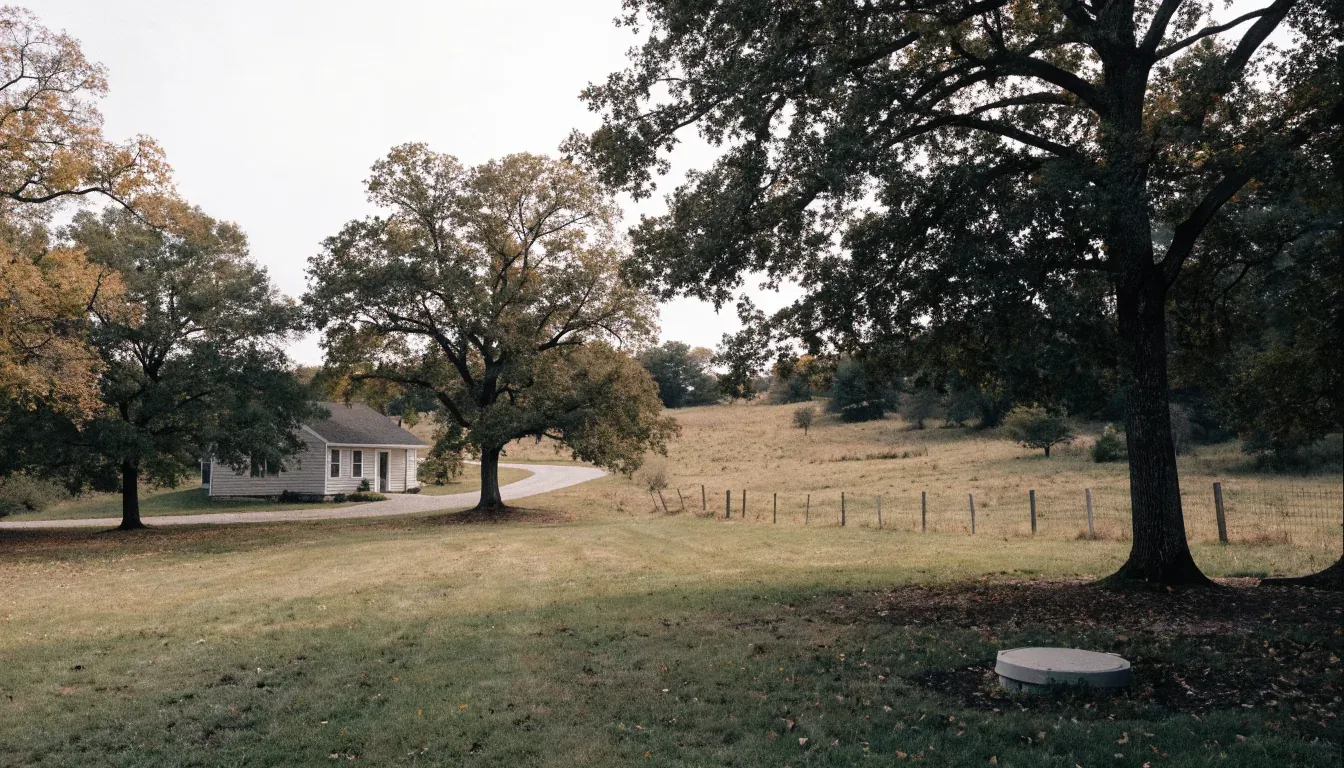

Septic tank installation in Wright City, Missouri
Wright City does not own its sewer. The plant that serves the town appears on Missouri's list of issued wastewater permits as the "Public Water Supply District No. 2, Wright City Wastewater Treatment Facility," and that district is a St. Charles County water district whose official of record sits in O'Fallon, one county east. So sewer or septic, the question that decides everything after it gets answered at a desk in another county, while the septic permit itself stays with Warren County. Call the district before anyone is paid for a soil evaluation.
Who issues a septic permit in Wright City, MO?
For property in the Wright City area the septic construction permit comes from the Warren County Sanitarian's Office in Warrenton, not from the water district that runs the sewer plant. Whether a lot inside Wright City limits is permitted by the county or by the city could not be confirmed here, so if your address sits inside the city line, ask both before you apply.
Warren County Sanitarian's Office. Phone (636) 456-7169. Their page: Warren County Sanitarian's Office.
Does public sewer reach my property in Wright City, MO?
The city has no city-owned sewer utility. The plant that serves Wright City appears on Missouri's list of issued site-specific wastewater permits as the "Public Water Supply District No. 2, Wright City Wastewater Treatment Facility," permit MO0140503, an operating permit effective August 1, 2026 and running to June 30, 2029. A second plant on the south side of town, the Wright City South Wastewater Treatment Facility, carries its own Missouri operating permit, MO0023191, in Warren County.
Public Water Supply District No. 2 is a St. Charles County district. On the state geohydrologic evaluation done for the Wright City plant in 2022, its organization official of record is listed at an O'Fallon address, one county east of the property you are asking about. The district's own water and sewer rules name "Wright City customers" as their own class of customer and refer to plumbers authorized to work in St. Charles and Warren counties, which is one district writing rules across two county lines.
So availability, the connection request and the sewer bill all belong to the district. Ask it two things: is a sewer main available to this parcel, and what would connecting involve. A water district can serve an address water without serving it sewer, so ask about sewer by parcel, not by street.
If the answer is no, you are on septic and the rest of this page applies. If it is yes, that changes the whole job, and finding out before paying for a soil evaluation is the point of asking first.
Why does a water district in another county run the sewer here?
Because the district, not the city, holds the plant. Missouri's permit list puts the district's name first on the facility, and the district is organized in St. Charles County, so the entity that decides whether a Warren County parcel can connect is governed one county east. Its published rules cover water and sewer together and carry Wright City customers as a named class, which is why the sewer answer, the connection request and the monthly bill all come off the same rule book as a St. Charles County water account.
This explains a common dead end. A homeowner calls the city, is told the city does not handle sewer, takes that to mean there is no sewer, and pays for a septic design on a lot that could have connected. The city is telling the truth. The question was just at the wrong desk.
It cuts the other way too. The district runs the plant, but it does not issue septic permits. Missouri lists the county as the onsite wastewater construction permit authority for Warren County, so a homeowner who calls the district about a permit gets sent back west. Two desks, two jobs: the district decides whether sewer is available, the county sanitarian decides what a septic system on the lot has to be.
Wright City is reported to have sold its water and sewer utilities to the district in 2018. The city's own account of that sale would not load, so the sale is not established on this page. What is established is who Missouri names on the plant's operating permit today.
What does the ground around Wright City do to a septic design?
Near level, tight and wet in the top three feet. Soil map units around Wright City include Putnam silt loam on 0 to 1 percent slopes, Mexico silt loam on 0 to 2 percent slopes and Chariton silt loam, poorly drained claypan prairie soils with a seasonal water table mapped within roughly nine inches of the surface.
The slope phases are the local point, and they are what makes this end of the corridor its own problem. At 0 to 2 percent there is very little fall between a house and a drainfield, and fall is what a gravity trench system uses to move water away from the house and spread it down a trench. Less fall means a shorter run of usable ground, less room to step trenches down a slope, and no easy way to put the field uphill of a wet spot. On ground this flat the layout question stops being where the good soil sits and becomes whether gravity can reach it at all, which is what pushes a design toward a pump and pressure distribution.
Below the soil, the picture is the opposite of the Ozark border south of the river. The Missouri Geological Survey visited a Wright City site on March 2, 2022, observed no bedrock at all, and reported roughly 100 feet of loess and alluvium over Mississippian-age Burlington-Keokuk Limestone, rating collapse potential Slight and overall geologic limitations Moderate. The limestone is far too deep to be anyone's problem here. The first three feet are the problem.
That has a direct design consequence. Missouri's construction rule keeps absorption trenches out of soils slower than 60 minutes per inch, and out of them in every case slower than 120 minutes per inch, and where a percolation test runs slower than 60 minutes per inch the design has to be drafted and signed by a registered engineer unless the soil evaluation established site suitability and sizing. A standard system also needs at least one foot between the trench bottom and the limiting layer or seasonal high water table. Flat claypan with a water table that close to the surface often will not size a conventional gravity field, and the design moves toward an engineered, pressure-dosed or lagoon system. The soil evaluation on your own lot decides which.
What does Warren County, MO require once the answer is septic?
The permit comes from the Warren County Sanitarian's Office in Warrenton, after a soil evaluation and before ground is broken, at a construction permit fee of $200.00 in the county's 2025 On-Site Sewage System Installation Procedure, and the full sequence, the forms and the current fees are on the Warren County page.
The Wright City hook is on the county's installer list: firms based in Wright City appear on it. Anyone paid for any part of the install has to be registered with Warren County, on top of the state requirement that any person installing an onsite sewage disposal system be registered with the Missouri Department of Health and Senior Services.
One caution about the city line. Wright City's municipal code is reported to set a much larger minimum lot size for a private subsurface absorption system inside city limits than the county does, which would be the biggest septic difference in the area. The code could not be read, so no figure is stated here as fact. If your address is inside the city, one call to the city and one to the sanitarian on (636) 456-7169 settles both that and who issues your permit.
What to have ready before you call a septic contractor in Wright City
An independent local septic contractor can size the job faster with the site facts in hand, and on this ground two of these change the design outright. Have the district's sewer answer before anything else; everything below assumes sewer is not available to the parcel.
Whether the address sits inside Wright City limits or in unincorporated Warren County. The two may be permitted differently and which applies inside the line is not established here.
Parcel size in acres or square feet, not a rough guess. Lot size decides what is allowed at all.
Bedroom count, existing and planned. Missouri sizes systems on bedrooms rather than people: the state's residential lagoon standard, for example, is 440 square feet of water surface per bedroom at the three-foot operating level.
Where the low wet spots sit after a hard rain, and whether there is any fall at all away from the house. On ground mapped at 0 to 2 percent that is the difference between a gravity design and a pumped one.
Well locations, yours and the neighbors'. The distances between a disposal area and a well are set statewide, not by Warren County, and they are on the Missouri septic permit page.
Whether a permit record already exists for the address. Ask the sanitarian; an old file can save a repeat soil evaluation.
Where the facts on this page come from
- Missouri DNR's issued site-specific wastewater permit list names the facility "Public Water Supply District No. 2, Wright City Wastewater Treatment Facility," permit MO0140503, Warren County, operating, effective 08/01/2026 and expiring 06/30/2029. Source: Missouri Department of Natural Resources, issued site-specific wastewater permits table, read 2026-08-27.
- The Wright City South Wastewater Treatment Facility holds its own Missouri operating permit, MO0023191, in Warren County. Source: Missouri Department of Natural Resources, facility record, read 2026-08-27.
- Public Water Supply District #2 of St. Charles County's own water and sewer rules treat Wright City customers as a distinct class of customer and refer to plumbers authorized to perform work in St. Charles and/or Warren County, Missouri. Source: Public Water Supply District #2 of St. Charles County, Water and Sewer Rules and Regulations, Rev. 38, read 2026-08-27.
- The Missouri Geological Survey's 2022 geohydrologic evaluation for the Wright City plant lists the organization official for Public Water Supply District No. 2 at an address in O'Fallon, Missouri, in St. Charles County. Source: Missouri Geological Survey, Geohydrologic Evaluation LWE22071, Warren County, March 22, 2022, read 2026-08-27.
- At the Wright City site visited on March 2, 2022, no bedrock was observed, surficial loess and alluvial material is roughly 100 feet thick based on nearby well logs, and bedrock is Mississippian-age Burlington-Keokuk Limestone. Source: Missouri Geological Survey, Geohydrologic Evaluation LWE22071, Warren County, March 22, 2022, read 2026-08-27.
- The same evaluation rated the site's overall geologic limitations Moderate and its collapse potential Slight. Source: Missouri Geological Survey, Geohydrologic Evaluation LWE22071, Warren County, March 22, 2022, read 2026-08-27.
- Putnam silt loam on 0 to 1 percent slopes, Mexico silt loam on 0 to 2 percent slopes and Chariton silt loam are mapped around Wright City, all poorly drained, with a water table at 20 to 23 cm (roughly eight to nine inches below the surface). Source: USDA NRCS Web Soil Survey, SSURGO soil survey of Warren County, Missouri, read 2026-08-27.
- Warren County's 2025 On-Site Sewage System Installation Procedure sets the on-site sewage system construction permit fee at $200.00 and has the permit issued after the soil evaluation and before construction begins. Source: Warren County Sanitarian's Office, On-Site Sewage System Installation Procedure, 2025, read 2026-08-27.
- Warren County requires anyone paid for any portion of a septic install to be a county registered installer, and the county's own registered contractor list includes firms based in Wright City. Source: Warren County Sanitarian's Office, septic install form and registered contractor list, read 2026-08-27.
- Missouri DHSS lists the Warren County Environmental Health Office (the county sanitarian) as the onsite wastewater construction permit authority for Warren County, on (636) 456-7169, and notes that the county has its own onsite wastewater ordinance which may add requirements beyond the state minimum construction standards. Source: Missouri Department of Health and Senior Services, onsite wastewater construction permit authority lookup, Warren County, read 2026-08-26.
- Where percolation tests run slower than 60 minutes per inch the design has to be drafted and signed by a registered engineer, unless site suitability and system sizing were established by a soil evaluation under section (7) of the rule. The rule says absorption trenches should not be constructed in soils slower than 60 minutes per inch, and in no case shall they be constructed in soils slower than 120 minutes per inch. Source: 19 CSR 20-3.060(2)(D) and (5)(A)1., Missouri Code of State Regulations, read 2026-08-26.
- The vertical separation between the bottom of an absorption trench and the limiting layer or seasonal high water table is to be no less than one foot for standard systems. Source: 19 CSR 20-3.060(5)(A)2., Missouri Code of State Regulations, read 2026-08-26.
- A residential sewage lagoon is sized at 440 square feet of water surface per bedroom at the three-foot operating level, and lagoons are intended for rural sites whose soils are demonstrated to be slower than 120 minutes per inch. Source: 19 CSR 20-3.060(6)(D), Missouri Code of State Regulations, read 2026-08-26.
- Any person installing onsite sewage disposal systems shall be registered to do so by the Missouri Department of Health and Senior Services. Source: Section 701.031, Revised Statutes of Missouri, read 2026-08-26.
Three Wright City specifics could not be confirmed. The city's municipal code is reported to bar a private subsurface soil absorption system on a lot smaller than 50,000 square feet inside city limits, but the city's code site refused every attempt to read it, so that figure is reported and not established and nothing on this page relies on it. For the same reason, whether a septic permit inside city limits is issued by the city or by the Warren County Sanitarian's Office is not established. The reported 2018 sale of the city's water and sewer utilities to Public Water Supply District No. 2 is unconfirmed too, because the city's own account of it would not load. One call to Wright City Hall and one to the sanitarian on (636) 456-7169 closes all three. Separately, the flat-ground point rests on Wright City's own mapped 0 to 1 and 0 to 2 percent slope phases; no comparative slope figure for any neighboring town is asserted here because none was read this pass.
Related
- Warren County, MO: the permit authority, the county requirements and the fees
- Septic design and soil evaluation, the step that comes first on claypan ground
- Septic system installation
- Drainfield replacement
- Soil evaluation and perc test: what the numbers mean
- Septic systems and lagoons in Missouri, and when a lagoon is the design
- Septic in the St. Louis metro
- Warrenton, MO: the county seat and the sanitarian's counter
- Wentzville, MO, next along I-70 in St. Charles County
- The Missouri septic permit, setbacks and who is allowed to do the work
- Looking up an existing septic record for an address
Get a free quote from a septic contractor near Wright City
Tell us the county and the job. No email needed.
A marketing service, not a licensed contractor. Septic work is performed by independent local contractors.
Need the job done, not just the rule explained
Your request goes straight to an independent local septic contractor serving your Missouri county, usually within about an hour during the day, not a national lead list.
Tell us the county and the jobLast reviewed 2026-08-27.