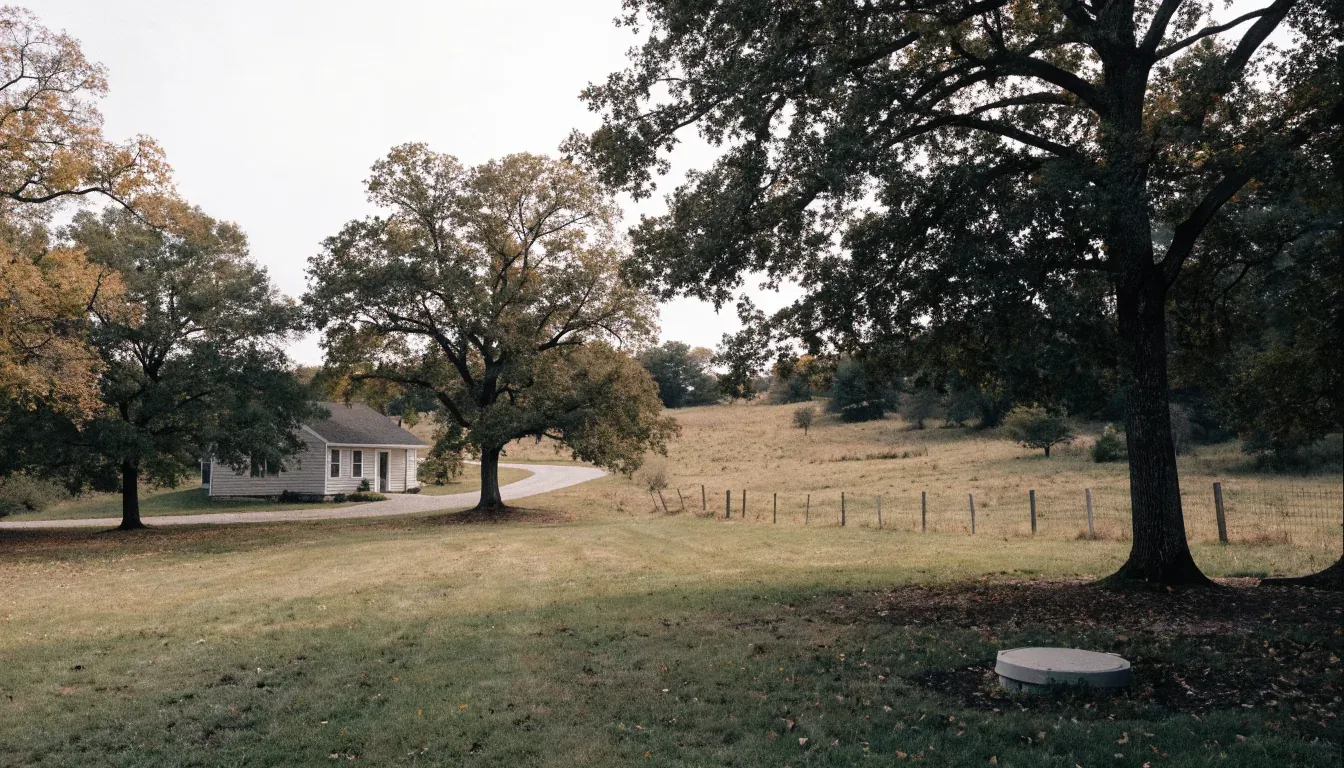

Septic tank installation in Wentzville, Missouri
Every rule that decides whether a new system can go in around Wentzville comes from St. Charles County, and two of them stack against almost any lot near the built-up part of town: a new system needs at least three acres, and where a viable public sewer is close enough, you connect to it instead. The city runs its own sewer collection system and its own treatment plant, and that system keeps extending, so the answer to "can I put a septic system here" moves further out every year. This page is about where that line sits now.
Who issues a septic permit in Wentzville, MO?
For unincorporated St. Charles County ground around Wentzville, the septic permit comes from the county, and the office is a building department rather than a health department. The county issues onsite wastewater permits in unincorporated St. Charles County and in cities it contracts with, but publishes no list of those contract cities, so whether Wentzville is one of them is not established here. It seldom comes up: the built-up city is sewered, and the septic work in this trade area sits on unincorporated ground outside the city limits, where the county is plainly the issuer.
St. Charles County Division of Building and Code Enforcement. Phone (636) 949-7345. Their page: St. Charles County Division of Building and Code Enforcement.
Is the property on Wentzville sewer, and how do you find out?
The City of Wentzville Wastewater Division owns and operates the sewer collection system and the Water Reclamation Center, permitted as NPDES MO-0093599, with design flow rising to 7.04 million gallons a day and discharge to McCoy Creek. Whether that collection system reaches a given address is what decides if a septic system is on the table at all.
Duckett Creek Sanitary District, which people often assume covers this end of the county, does not reach Wentzville. Its published service area is Cottleville, Weldon Spring, most of Dardenne Prairie, part of the City of St. Charles, and the southern portions of O'Fallon and St. Peters, which puts its boundary east and southeast of town. Unsewered ground near Wentzville starts outside the city sewer area, on county land also outside Duckett Creek.
Neither the city nor the district publishes a service boundary you can read off a screen, so the check is a phone call.
Call the City of Wentzville Wastewater Division and ask whether the address can connect to city sewer.
Then call the St. Charles County Division of Building and Code Enforcement at (636) 949-7345 with the parcel and ask whether a system could be permitted there at all.
If sewer is available under the county's 200-foot test, a new system is off the table and the money goes to the connection.
Why two St. Charles County, MO rules close off new septic near Wentzville
Two county rules stack in a way that matters more around Wentzville than in most of the metro. First, a minimum of three acres is required for the installation of a new onsite wastewater treatment system, countywide. Second, in the county's own published wording, if a viable public sewer is within 200 feet of the property, you must connect to public sewer.
The two do different work here. The 200-foot trigger takes out the subdivided fringe, where the collection system already runs past the front of the lot. The three-acre floor takes out most of what the sewer rule misses, because the parcels platted just outside the city are rarely that big. What is left is rural ground well outside the sewer envelope, and that is where a new system in this trade area actually goes.
The sewered area is not fixed. The Water Reclamation Center's permitted design flow is set to rise to 7.04 million gallons a day, so a parcel outside the 200-foot trigger a few years ago can be inside it now. The test is availability today, not what was true when the land was bought.
What the ground around Wentzville does to a septic design
Wentzville sits on loess over glacial till upland, north of the Missouri River. Depth to bedrock is usually not what decides the design here, and the mapped components are loess and till soils rather than the cherty residuum of the Ozark border. The soils mapped around town are Armster (loess over till), Mexico, Hatton and Keswick. USDA NRCS rates every major component here very limited for septic tank absorption fields, with certain Menfro map units the only somewhat limited exception.
The two reasons NRCS gives are the two things a designer fights here: slow water movement in the 60 to 180 cm layer, and a saturated zone at 120 to 180 cm, a seasonal perched water table sitting right where a trench needs vertical separation. Saturated hydraulic conductivity in the 25 to 120 cm layer runs from 0.20 micrometers per second on Hatton and 0.30 on Mexico up to 3.0 to 9.0 on Menfro, a wide spread over a short drive, which is why a neighbor's working system is not evidence about your lot.
So a conventional gravel and pipe trench sizes large on Hatton and Mexico ground, or does not pass the soil evaluation at all. The county accepts every conventional and alternative type except lagoons and wetlands, including gravelless, chamber, dosing, sand filter, peat or bio filter, mound and subsurface drip distribution. It also deleted the percolation test sections from the code it adopted, so what you may build is set by a soil morphology evaluation from an approved soil evaluator rather than by a perc rate, and an alternative system must be designed by a professional engineer licensed in Missouri.
What St. Charles County, MO requires, in short
The full picture, including the ban on new lagoons, is on the St. Charles County page. The items that most often change a decision near Wentzville:
Three acres minimum for a new system, countywide.
Connection to public sewer where a viable public sewer is within 200 feet.
A permit for installing, modifying, altering, adding to or repairing any system treating 3,000 gallons a day or less, so a repair is permitted work too.
County setbacks that go past the state table, including 30 feet from any property line for tanks and absorption fields, against the state table's 10 feet.
Evidence of ongoing maintenance: conventional systems at least every five years, alternative systems yearly.
Selling a house on septic near Wentzville
St. Charles County requires an inspection when a house served by a private sewage disposal system is sold, and it licenses a dedicated onsite wastewater inspector business license whose stated scope is inspection of systems at transfer of ownership, adopted at OSCCMo 626.
Order that inspection early. If the system does not meet county code, the fix is permitted work, and the permit takes time.
What to have ready before you call a contractor
Have these ready and the first call is a short one.
Calls from this page reach an independent local septic contractor who works St. Charles County. This site explains the permitting and routes the request; it does not perform the work.
The parcel number or exact address, the lot size in acres, and whether it sits inside the city limits or in unincorporated county.
The answer from the City of Wentzville Wastewater Division on whether the address can connect to city sewer.
Any existing permit or system records the county holds for the property.
The location of any private well on or beside the lot, since a new sewage tank must sit 100 feet from a private water supply.
The number of bedrooms the system has to serve.
Whether this is a new install, a replacement, a repair, or a sale inspection. Those are different permits and different timelines.
Where the facts on this page come from
- A minimum of three acres is required for the installation of a new onsite wastewater treatment system in St. Charles County. Source: St. Charles County, MO, Community Development, Onsite Wastewater Treatment Systems FAQ, read 2026-08-27.
- The county's published wording on sewer connection: if a viable public sewer is within 200 feet of the property, you must connect to public sewer. Source: St. Charles County, MO, Onsite Wastewater Treatment Systems FAQ, read 2026-08-27.
- A permit is required for the installation, modification, alteration, addition to, or repair of any system treating 3,000 gallons or less of waste per day. Source: St. Charles County, MO, Onsite Wastewater Treatment Systems FAQ, read 2026-08-27.
- St. Charles County does not allow the installation of new lagoons, and does not allow the surfacing of sewage regardless of property ownership. Source: St. Charles County, MO, Onsite Wastewater Treatment Systems FAQ, read 2026-08-27.
- System options are determined by a soil morphology evaluation conducted by an approved soil evaluator, and alternative systems must be designed by a professional engineer licensed in the State of Missouri. Source: St. Charles County, MO, Onsite Wastewater Treatment Systems FAQ, read 2026-08-27.
- The county allows all conventional and alternative system types other than lagoons and wetlands, including gravel and pipe, gravelless, EPS gravelless, chamber, dosing, sand filter, peat or bio filter, mound and subsurface drip distribution, where the site and soil allow. Source: St. Charles County, MO, Onsite Wastewater Treatment Systems FAQ, read 2026-08-27.
- The Division of Building and Code Enforcement issues permits in unincorporated St. Charles County and in cities it contracts with, lists (636) 949-7345 as its contact number, and directs applicants to a permit lookup tool rather than publishing a list of those cities. Source: St. Charles County, MO, OWTS Permitting and Inspection, read 2026-08-27.
- The substantive rules for all onsite systems in the county come from the 2021 St. Charles County Private Sewage Disposal Code, adopted at OSCCMo 500.300. Source: St. Charles County, MO, Onsite Wastewater Treatment Systems page, code adoption table, read 2026-08-27.
- An inspection is required when selling a house served by a private sewage disposal system in St. Charles County. Source: St. Charles County, MO, Building and Code Enforcement Division FAQ, QID 237, read 2026-08-27.
- The county licenses an Onsite Wastewater Treatment System Inspector Business License whose stated scope is inspection of systems at transfer of ownership, adopted at OSCCMo 626. Source: St. Charles County, MO, Onsite Wastewater Treatment Systems page, code adoption table, read 2026-08-27.
- County setbacks go past the state table: on new construction a sewage tank must be 100 feet from any private water supply, and sewage tanks and absorption fields must be 30 feet from any property line, against the state table's 10 feet. The county also deleted the percolation test sections from the code it adopted, and requires evidence of maintenance at least every five years for conventional systems and yearly for alternative systems. Source: St. Charles County, MO, 2021 Private Sewage Disposal Code amendments, read 2026-08-26.
- The City of Wentzville's Wastewater Division includes the sanitary sewer collection system and the Water Reclamation Center. Source: City of Wentzville, Wastewater Division, read 2026-08-27.
- The Wentzville Water Reclamation Center is NPDES MO-0093599, with design flow increasing to 7.04 million gallons a day and discharge to McCoy Creek in St. Charles County. Source: Missouri Department of Natural Resources, Construction Permit No. CP0002184, Wentzville WRC, effective March 17, 2021, read 2026-08-27.
- Duckett Creek Sanitary District's service area is Cottleville, Weldon Spring, the majority of Dardenne Prairie, a small portion of the City of St. Charles, the southern portions of O'Fallon and St. Peters, and adjacent unincorporated areas. Wentzville is not in it. Source: Duckett Creek Sanitary District, Facilities, read 2026-08-27.
- The dominant mapped soil components around Wentzville are Armster (loess over till, moderately well drained), Mexico (poorly drained), Keswick and Hatton. USDA NRCS rates every major component very limited for septic tank absorption fields, with certain Menfro map units rated somewhat limited. Source: USDA NRCS Web Soil Survey, SSURGO survey area MO183, St. Charles County, Missouri, read 2026-08-27.
- The NRCS limiting reasons for those soils are slow water movement in the 60 to 180 cm zone and depth to a saturated zone at 120 to 180 cm. Saturated hydraulic conductivity between 25 and 120 cm: Hatton 0.20, Mexico 0.30, Goss 0.90, Armster 1.0, Keswick 1.0 to 3.0 and Menfro 3.0 to 9.0 micrometers per second. Hatton carries a mapped restrictive layer at 81 cm. Source: USDA NRCS Web Soil Survey, SSURGO survey areas MO183 and MO113, read 2026-08-27.
Five things are not established here. One, the code text itself could not be read: the 2021 St. Charles County Private Sewage Disposal Code and code sections OSCCMo 500.300 and 626 are hosted on third-party sites that refused every request this session, so the county rules above come from the county's own FAQ and department pages, which are county publications summarizing the code rather than the code. Two, code language allowing the Division to approve existing parcels under three acres case by case could not be confirmed against the code, so the exception is unverified, three acres should be treated as the rule, and the exception is a question for the Division rather than a plan. Three, the county's published wording measures the 200-foot sewer test from "the property"; the exact measuring point was not confirmed against the code, so confirm it with the Division for a specific parcel. Four, neither the City of Wentzville nor Duckett Creek publishes a service-area boundary that could be read, so where the sewered area ends here is established by the city running its own plant and Duckett Creek naming a service area that excludes Wentzville, not by a mapped line. Whether Wentzville is one of the cities the county holds a permitting contract with is also not published. Five, Goss appears in the SSURGO component list for this survey area but forms in residuum from cherty limestone rather than in the loess and till the town sits on, and it was not confirmed at town grain, so it is left out of the soil discussion above until that component list is re-read.
Related
- St. Charles County, MO septic rules and permitting
- Septic system installation
- Septic design and soil evaluation
- Septic inspection before a sale
- Soil evaluation and perc test in Missouri
- Septic in the St. Louis metro
- Septic tank installation in the St. Louis metro
- What the septic permit application asks for
- Look up existing septic records
- Septic systems and lagoons in Missouri
- Wright City, MO
- Warrenton, MO
Get a free quote from a septic contractor near Wentzville
Tell us the county and the job. No email needed.
A marketing service, not a licensed contractor. Septic work is performed by independent local contractors.
Need the job done, not just the rule explained
Your request goes straight to an independent local septic contractor serving your Missouri county, usually within about an hour during the day, not a national lead list.
Tell us the county and the jobLast reviewed 2026-08-27.