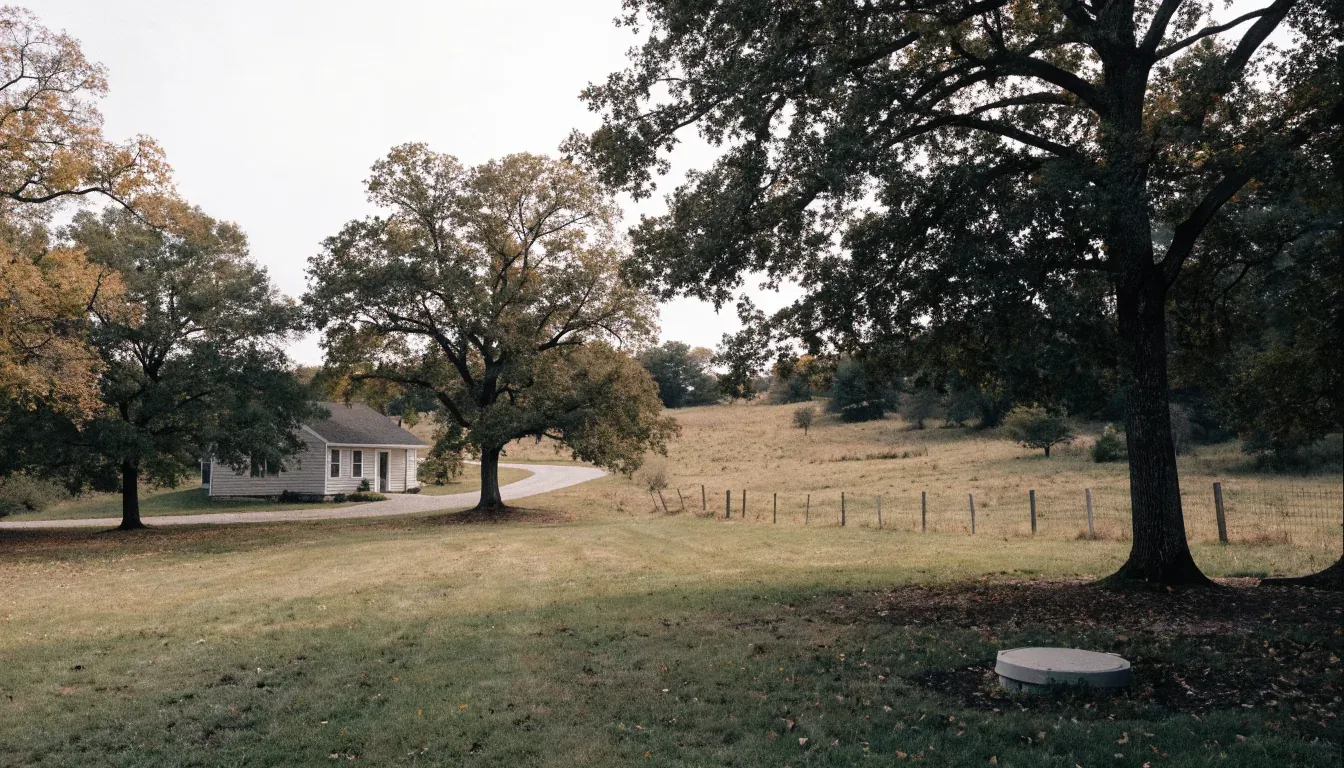

Septic installation and replacement in Warren County, Missouri
Warren County is a third-class county, so in the words of its own master plan it "cannot administer a building code for new construction". It reviews development through zoning permits instead, and it runs a separate septic order that permits and inspects onsite systems. The lever that makes it stick is electricity. The master plan says Cuivre River Electric Co-op and Ameren U/E withhold electrical service unless the county has certified compliance with local septic regulations, and the Sanitarian's installation steps say the zoning administrator releases the permanent electric sticker after the final inspection of the sewage system. So the order of operations is not the one most homeowners expect: soil evaluation first, then the suggested installation sheet from the Sanitarian, then the county permit before ground is broken, then inspection each day of major work, then permanent power. On the state permit question, read the qualification carefully. Missouri's permit requirement in section 701.046 opens "Except as otherwise provided in section 701.031", and 701.031 carries a large-lot exclusion with strict conditions. That exclusion is a state-level carve-out, not a county one. Warren County permits under its own ordinance, so plan on a county permit and a county registered installer here regardless of lot size, and confirm with the Sanitarian before assuming otherwise. For the full list of what to ask a contractor before hiring, see the hub page at /st-louis-septic/.
Who issues a septic permit in Warren County, MO?
The Warren County Sanitarian's Office. That is the office to call before anything else, because in Missouri the permitting authority is not the same kind of agency in every county, and assuming it is the health department wastes a week in the counties where it is not.
Phone (636) 456-7169. Their page: Warren County Sanitarian's Office.
Source: Missouri Department of Health and Senior Services, onsite wastewater construction permit authority lookup for Warren County, read 2026-09-12. Fees, forms and requirements change, and this county is the only current source for its own.
What does Warren County require beyond the state standard?
- Missouri DHSS lists the Warren County permit authority as the Warren County Environmental Health Office (Health Dept.) and the authority type as "Ordinance". The DHSS alert reads: "Contact the agency above for onsite wastewater permitting instructions. This county has their own Onsite Wastewater Ordinance and may have additional requirements beyond the state minimum construction standards." The permit comes from the county, not from the state. Source: Missouri Department of Health and Senior Services, OWTS Construction Permit Required, county permit authority lookup, Warren County entry, read 2026-08-27.
- The county master plan states: "The Warren County Planning and Zoning Office issues zoning permits based on zoning compliance. As a third-class county, Warren County cannot administer a building code for new construction. Warren County does have a septic order that provides for the permitting and inspection of on-site septic systems. The Cuivre River Electric Co-op and Ameren U/E support the enforcement of these codes by withholding electrical service unless the County has certified compliance with local septic regulations." Source: Warren County, Missouri Master Plan, Development Review and Approval, page 15, read 2026-08-27.
- Step 3 of the county procedure: "A County permit must be obtained prior to breaking ground. System design sheets must be submitted before a permit will be issued." If the property owner named on the deed cannot obtain the permit, a signed, notarized affidavit giving someone else permission is required. "The permit expires 1 year from the date of issuance and is not issued the same day." Source: Warren County Sanitarian, On-Site Sewage System Installation/Major Repair Steps, Rev 02/25, read 2026-08-27.
- Step 1 is a soil evaluation, which "must be completed by a soil scientist who meets the requirements of the Missouri Department of Health and Senior Services". The Sanitarian's office keeps a listing of qualified soil scientists doing business in Warren County. In Step 2 that office uses the soil information and a calculated flow rate to complete a suggested installation sheet and mails it to the client named on the soil evaluation. The sheet gives minimum system sizes only, and the county recommends building above the minimum. Soil work drives the design here rather than confirming it. Source: Warren County Sanitarian, On-Site Sewage System Installation/Major Repair Steps, Rev 02/25, read 2026-08-27.
- What to bring when applying for the septic permit: the completed Request for On-site Sewage Inspection/Permit, a recorded warranty deed if the property was purchased less than six months ago, an address assignment from the 911 Business Office on (636) 456-7088, the soil evaluation, and photo identification. Source: Warren County Sanitarian, On-Site Sewage System Installation/Major Repair Steps, Rev 02/25, read 2026-08-27.
- "If any person is paid for any portion of installing the system, they must be a Warren County registered installer." Everyone constructing or making a major modification or major repair must file a completed system design form before the work and give prior notice to the office of major work each day it is performed. Owners working on their own systems are included in that requirement and in addition must meet with the Sanitarian before any work on the system. The office keeps a listing of installers registered by MDHSS and by Warren County. Source: Warren County Sanitarian, On-Site Sewage System Installation/Major Repair Steps, Rev 02/25, read 2026-08-27.
- The current county septic permit fee is stated on the procedure sheet as "Wastewater Permit fee: $200.00 (payable after permit is approved, Photo ID)". The Sanitarian's own web page carries the same figure: "SEWER PERMIT FEES ARE: $200.00". Source: Warren County Sanitarian, On-Site Sewage System Installation Procedure 2025, read with the Warren County Sanitarian page, read 2026-08-27.
- Step 4 of the county procedure: proper notification each day major work is conducted lets the office inspect during construction, and "When the sewage system is completed and a final inspection is conducted, the zoning administrator will release the permanent electric sticker." Zoning does not allow a home constructed off-site to be placed on a property, and does not issue a permanent electric sticker for a new residence, until the Sanitarian has completed a final inspection of the sewage system. A finished house with no passing septic inspection does not get permanent power. Source: Warren County Sanitarian, On-Site Sewage System Installation/Major Repair Steps, Rev 02/25, read 2026-08-27.
- The county design sheet is titled "System Design, to be complete by installer and returned prior to excavation" and asks the installer to check whether they are registered. Its site layout instructions read: "Show locations of all soil morphology test pits. Holes must be flagged on the property for site evaluation. Show fence location around waste stabilization pond." Physical flags in the ground are part of the paperwork here. Source: Warren County Sanitarian, On-Site Design Sheet, read 2026-08-27.
- Warren County Planning and Zoning publishes a Schedule of Fees effective February 3, 2026. Sanitation: Septic Permits $200.00; Holding Tanks, annual inspection $50.00, late fee may apply. Construction permits: single family residence and manufactured dwelling $150.00; mobile home, recreational vehicle or camper $100.00; home addition and in-ground pool $70.00; improvements and additions of 120 square feet or less, no charge. Electric stickers upon request $10.00. The sheet also warns: "If the correct permit(s) is not obtained before project is started, fee will double." Source: Warren County Planning and Zoning, Schedule of Fees effective February 3, 2026, read 2026-08-27.
- Warren County zoning covers "all land in the County not within the corporate limits of any city, town or village", divided into 11 districts including a Missouri River Flood Plain District and a Conservation District. Minimum lot size in the Agricultural and General Development districts is three acres, at one dwelling per three acres, with a minimum structure setback of 50 feet from the edge of an easement, right of way, or public or private road. R-2 is one acre, R-1 is 15,000 square feet, and the Community Development district is two acres. Source: Warren County Planning and Zoning, Structure Setbacks effective 9-17-12, with Zoning Code Article III Section 3.1, read 2026-08-27.
- The Missouri permit requirement is not stated absolutely in the statute. Section 701.046 reads: "Except as provided in section 701.031, no person may construct or make a major modification or major repair to an onsite sewage disposal system without first notifying the city, county or department, completing an application on a form provided by the department, submitting the application fee in the amount established by that city, county or department, and obtaining a construction permit." Source: Section 701.046, Revised Statutes of Missouri, read 2026-08-26.
- The exclusion the permit statute points to: the owner of a single-family residence lot of three acres or more, or of a residential lot of ten acres or more with no single-family residence onsite sewage disposal system within three hundred sixty feet of any other one and no more than one single-family residence per ten acres in the aggregate, is excluded from sections 701.025 to 701.059 and the rules made under them, including the provisions on construction, operation, major modification and major repair. The exclusion does not reach lots adjacent to lakes operated by the Corps of Engineers or by a public utility, and it applies only when all points of the system sit more than ten feet from any adjoining property line and no effluent enters an adjoining property, contaminates surface water or groundwater, or creates a nuisance as determined by a readily available scientific method. It is a state-level exclusion: a county that regulates under its own ordinance, as Warren County does, still requires its own permit. Source: Section 701.031, Revised Statutes of Missouri, read 2026-08-26.
- Missouri defines a major modification or major repair as the redesigning and alteration of an onsite sewage system by relocation of the system or a part of it, replacement of the septic tank, or construction of a new absorption field. That definition is what pulls a tank replacement or a new lateral field into permitted work, subject to the section 701.031 exclusion above and to whatever the county ordinance requires. Source: Section 701.025(6), Revised Statutes of Missouri, read 2026-08-26.
- The design requirement that matters most on Warren County ground: the vertical separation between the bottom of an absorption trench and the limiting layer or seasonal high water table is to be no less than one foot for standard systems, and highly permeable soils, and cherty clay soils in areas of severe geological limitations, require four feet to groundwater or bedrock. Source: 19 CSR 20-3.060(5)(A)2., Missouri Code of State Regulations, read 2026-08-26.
- General soil map shares of Warren County, from the county's own USDA soil survey. Goss-Gasconade-Chilhowie about 24 percent, formed in residuum weathered from limestone and shale, moderately sloping to very steep, with "elevation differences of 250 feet or more within one-fourth mile" common; the unit is about 25 percent Gasconade-Rock outcrop complex, where "limestone bedrock is at a depth of about 18 inches", and its Chilhowie soils have "limestone bedrock at a depth of 28 inches". Keswick-Lindley about 18 percent, formed in glacial till. Mexico-Armster-Putnam about 17 percent, the loess-covered till plain prairie unit. Hatton-Keswick-Marion about 15 percent, on narrow winding ridgetops, with a fragipan below the Hatton subsoil. Winfield-Menfro about 13 percent, loess adjacent to the Missouri River flood plain, where "gullying is a very serious hazard". Blake-Haynie-Booker about eight percent, the Missouri River flood plain, where "a high water table occurs in times of sustained rises in the Missouri River". Source: USDA Soil Conservation Service, Soil Survey of Montgomery and Warren Counties, Missouri, 1978, General Soil Map, read 2026-08-27.
- Mexico series, the claypan soil of the county's prairie unit: "very deep, poorly drained soils formed in loess over loamy sediments derived from till", slopes 0 to 4 percent. Depth to top of the claypan 18 to 46 centimeters (7 to 18 inches). Particle-size control section "averages 38 to 50 percent clay, with at least one horizon having 45 to 60 percent". "Permeability is very slow. Saturated hydraulic conductivity (Ksat) is 0.01 to 0.42 micrometers per second. In undisturbed areas a perched water table has an upper limit of 15 to 61 centimeters (0.5 to 1.5 feet) during December to May in most years." Source: USDA NRCS Official Series Description, MEXICO series, read 2026-08-27.
- Menfro series, the loess soil of the Missouri River uplands: "very deep, well drained, moderately permeable soils formed in thick loess deposits on upland ridgetops, backslopes and benches adjacent to the Missouri and Mississippi Rivers and their major tributaries. Slopes range from 2 to 60 percent." Loess deposits range from 6 to 20 feet or more thick. "Permeability is moderate. Saturated hydraulic conductivity is moderately high or high (4.0 to 14.11 micrometers/sec)." Source: USDA NRCS Official Series Description, MENFRO series, read 2026-08-27.
Missouri lets a county adopt standards more restrictive than the state's, so a requirement here is not evidence of the same requirement one county over.
Source: Missouri Department of Health and Senior Services, Onsite Wastewater Treatment, read 2026-09-12.
What is the ground like in Warren County?
Warren County is not one ground, and the 1978 USDA soil survey of Montgomery and Warren Counties puts percentages on the split. The largest share, about 24 percent of the county, is the Goss-Gasconade-Chilhowie unit: stony soils weathered from limestone and shale on steep to very steep hillsides, where elevation differences of 250 feet or more within a quarter mile are common. About a quarter of that unit is the Gasconade-Rock outcrop complex, with limestone bedrock at about 18 inches, and the Chilhowie soils in it have limestone at 28 inches. That is the hardest ground in the county for a lateral field, because the state minimum construction standard asks for four feet to groundwater or bedrock in cherty clay soils in areas of severe geological limitations, against one foot for a standard system. About 18 percent is Keswick-Lindley, clay subsoils formed in glacial till on side slopes. About 17 percent is the Mexico-Armster-Putnam prairie unit, the claypan ground in the county. The current USDA series description makes Mexico poorly drained with very slow permeability, the top of its claypan seven to 18 inches down, its particle-size control section averaging 38 to 50 percent clay with at least one horizon at 45 to 60 percent, and a perched water table in undisturbed areas with an upper limit of half a foot to 1.5 feet from December to May in most years. A seasonal water table that high is a direct problem for the one-foot vertical separation a standard trench needs, which is part of why the county starts every project with a soil evaluation rather than a percolation test. About 15 percent is Hatton-Keswick-Marion on narrow, winding ridgetops, where the Hatton subsoil sits over a fragipan. About 13 percent is Winfield-Menfro, loess uplands next to the Missouri River flood plain, the ground around Marthasville and Dutzow. Menfro is well drained with moderate permeability, but its slopes run from two to 60 percent and the county survey calls gullying a very serious hazard there, so the constraint flips from drainage to finding enough level run and holding the field in place. About eight percent is the Blake-Haynie-Booker flood plain unit on the Missouri River, where a high water table follows sustained rises in the river, and that acreage sits inside the county's Missouri River Flood Plain zoning district.
That matters because the soil decides the system. A standard system needs at least one foot between the trench bottom and the limiting layer or seasonal high water table, rising to four feet to groundwater or bedrock in highly permeable soils and in cherty clay soils in areas of severe geological limitations, and a percolation rate slower than sixty minutes per inch pulls a registered engineer onto the design.
The soil evaluation is what settles it for your particular lot.
Source: 19 CSR 20-3.060(5)(A)2., Missouri Code of State Regulations, read 2026-09-12.
Which towns does this cover?
Warren County has Warrenton as its county seat. Places served include Warrenton, Wright City, Truesdale, Marthasville, Innsbrook, Dutzow, Pendleton, Foristell. Anywhere in the county not on a public sewer is on a system this page applies to.
Who is allowed to do the work here?
An installer registered with the Missouri Department of Health and Senior Services. That is a state requirement rather than a county one. The statute carrying it also carries a large-lot exclusion for some single-family lots of three acres or more, on strict conditions, and a county regulating under its own ordinance can require its own permit and its own registration regardless, which is what the collar counties around St. Louis do. Some counties add their own licensing on top of the state registration, which is one more reason to ask the permitting authority what they require before you sign anything.
Who is allowed to do the work covers what registration means here.
Source: Section 701.031, Revised Statutes of Missouri, read 2026-09-12.
What we could not confirm for this county
The text of the county's septic order itself is not published online. Its existence is solid: the county master plan states it, DHSS classifies Warren as an ordinance county, and the Sanitarian's procedure sheet operates under it. But no county-specific setback, minimum lot area for a system, or tank and field sizing number is quoted on this page, because none was read. The Sanitarian's office is the source for those, by phone on (636) 456-7169 or by a records request. Two smaller holes. DHSS names the permit authority as the Warren County Environmental Health Office at a Warrenton address, while the county's own page names the Warren County Sanitarian's Office at 101 Mockingbird Lane, Suite 201, with the same phone number on both, so call before driving out. And the zoning code covers only land outside the corporate limits of any city, town or village, so whether the septic order reaches inside an incorporated place, including the Village of Innsbrook, is not published and has to be confirmed with the county.
Get a free quote from a septic contractor in Warren County
Tell us the county and the job. No email needed.
A marketing service, not a licensed contractor. Septic work is performed by independent local contractors.
Need the job done, not just the rule explained
Your request goes straight to an independent local septic contractor serving your Missouri county, usually within about an hour during the day, not a national lead list.
Tell us the county and the jobLast reviewed 2026-09-12.