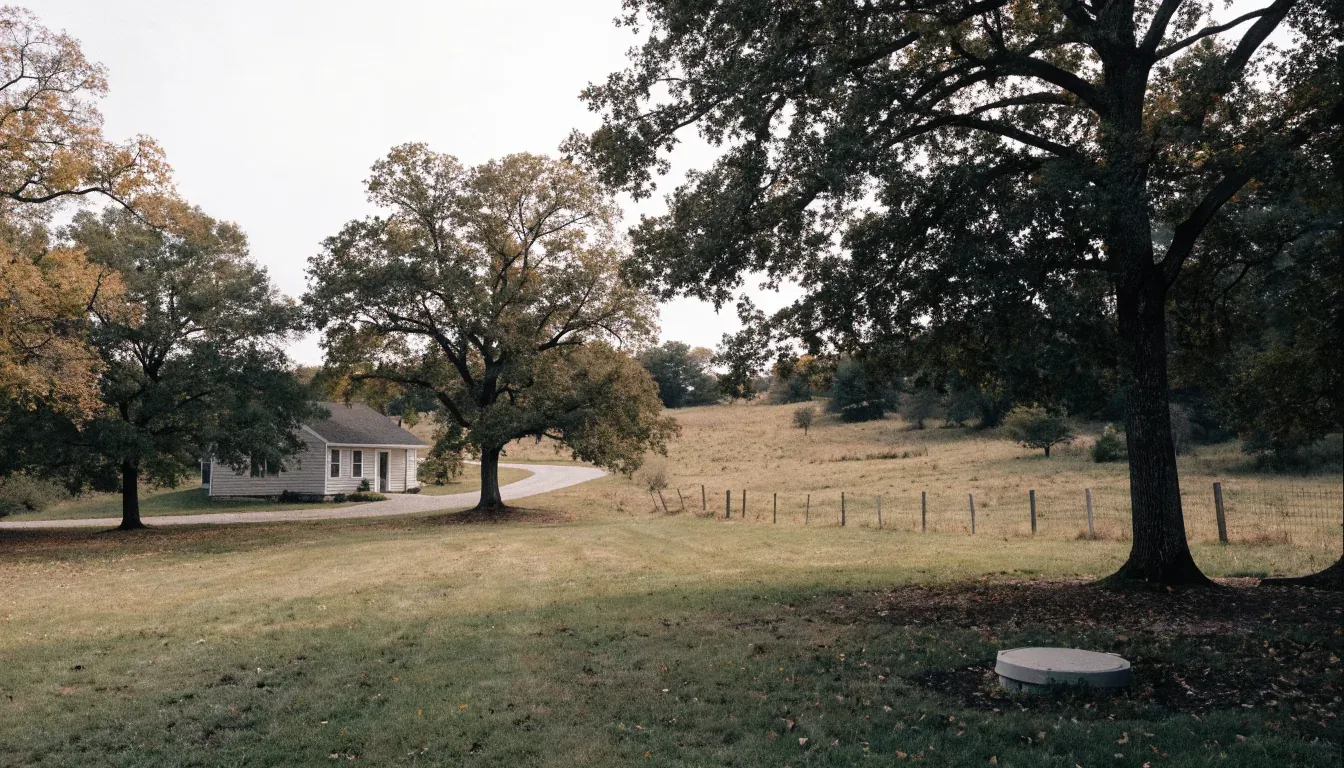

Septic tank installation in High Ridge, Missouri
High Ridge sits on the ridge-top uplands above the Meramec valley, and the USDA soil survey of Jefferson County put a High Ridge scene on its cover to illustrate the Sonsac-Useful-Moko soil association that covers 58 percent of the county. That association is cherty soil over dolostone and limestone, so on a ridge lot the thing that decides your septic design is how far down the rock sits. High Ridge is unincorporated, which means the county permit is the only permit and there is no city layer above it. Two different sewer districts also operate inside the community, so the town name tells you nothing about whether your lot is already sewered.
Who issues a septic permit in High Ridge, MO?
High Ridge is a census-designated place, not an incorporated city, so no city hall sits between you and the county and there is no separate municipal septic permit to chase. Jefferson County Code Enforcement regulates construction in unincorporated Jefferson County, which is where every High Ridge address falls, and it applies the county's own On-Site Sewage Treatment Code, Chapter 705, rather than the state standard alone.
Jefferson County Code Enforcement. Phone (636) 797-5310. Their page: Jefferson County Code Enforcement.
Sewered or not, and why the answer changes street by street in High Ridge
The ridge was built out subdivision by subdivision, and the sewer followed the same way, so the line between sewered and unsewered here runs along plat boundaries rather than along any town edge. Rock Creek Public Sewer District names High Ridge among the places it serves. Northeast Public Sewer District runs a small treatment plant on Walnut Valley Drive under a Missouri DNR operating permit, sized for a design population equivalent of 144 and a design flow of 14,400 gallons per day, a package plant serving one pocket of homes rather than the community.
Everything unincorporated in the county that is not already inside another district falls to Jefferson County Public Sewer District, whose stated boundary is all unincorporated Jefferson County except territory already served by another district, about 540 square miles. Most of High Ridge is not on a collection line at all.
Neither district publishes a parcel-level or street-level service map, so the only way to settle your address is to call both with it in hand. Rock Creek publishes its contact details on its district site; Northeast answers from its Fenton office. If a main runs in your street and you can tie in, the septic question ends there. Chapter 705 also deems a sewer available when any part of it is within 400 feet of the property line, so a line that stops short of your driveway can still be the county's answer on a new system.
What does the ground under High Ridge do to a septic design?
High Ridge sits on the Sonsac-Useful-Moko soil association, the largest in Jefferson County at 58 percent of the survey area, formed in loess and residuum with slopes running three to 55 percent. Sonsac is 44 percent of it: moderately deep, gravelly colluvium over clayey residuum weathered from cherty dolostone and limestone. Moko is another 15 percent, very shallow to shallow over dolostone. Useful, the other 30 percent, is a thin loess cap on slowly permeable clayey residuum.
USDA rates all three Very limited for septic tank absorption fields, and the reason differs by soil, which is the whole design. Sonsac and Moko score depth to bedrock at 1.00, the maximum limitation value on a scale running 0.00 to 1.00. Useful scores wetness at 1.00 and percs slowly at 0.71, with no bedrock limitation at all. Goss, a minor soil here, is limited on slope at 1.00.
The ground does a second thing here. The county soil survey warns that the Kimmswick limestone sequence contains many sinkholes that when disturbed lead to direct groundwater contact and potential contamination. Missouri's construction standard treats a disposal field within 100 feet, or a sewage tank within 50 feet, of the topographic drainage of a sinkhole as significant groundwater contamination potential, and the county's own Table 602.1 holds a treatment area 100 feet from the edge of a surficial sinkhole. Antire Creek, which receives the discharge from that small plant inside High Ridge, is marked losing by DNR. A closed depression in the yard is not a landscaping detail on this ground, it is a setback.
The ridge-top case: what a design does when there is not enough depth to bedrock
A conventional gravity trench field works by putting effluent into soil and giving it vertical room to travel before it meets rock or water. The state floor is one foot between the trench bottom and the limiting layer, rising to four feet to groundwater or bedrock in highly permeable soils and in cherty clay soils in areas of severe geological limitations. Jefferson County sets a higher bar in Chapter 705: three feet of soil between the bottom of the absorption system and high groundwater or bedrock, 48 inches of suitable soil for a conventional field, and no conventional system on a slope over 20 percent. On Sonsac and Moko the rock is often not that far down, and trench depth plus the required separation can add up to more soil than the ridge actually has.
When that happens the trench field does not get smaller, it stops being an option. The design moves up out of the profile instead of down into it: shallow filled trenches, which the county allows with two feet of natural soil separation and fill extending at least 20 feet past the trenches in all directions, low pressure pipe laid in the top of the soil, drip dispersal spread thin over a wide area, a mound or sand filter that imports the medium the ridge does not supply, or an aerobic unit that treats the effluent first so less soil has to. Each is an engineered design, and the county wants those drawings stamped on every page.
Down the hill at House Springs the limiting factor flips: there the problem is water, flooding and wetness in the bottomland, not rock. Same county, same code, opposite design. A number a neighbor got three miles away is worth very little on a ridge lot.
So the soil morphology report is not paperwork on a High Ridge lot, it is the document that decides what you are buying. It gets dug and read before anything is designed, and it can come back saying the conventional system your budget assumed will not fit at all.
What does Jefferson County, Missouri require for the permit?
The full county picture sits on the Jefferson County page. What applies to a High Ridge job: the application goes to Code Enforcement in Hillsboro, and three full sets of sealed plans and soils reports go with it. A newly created lot served by an on-site system needs at least 87,120 square feet, two acres, and Chapter 705 allows one system per recorded lot.
A new system needs a soil morphology report with three sample pages, four if it is a new home, engineered sewer drawings stamped on every page, and a contractor verification form completed by an active on-site septic contractor. The contractor signs on to your application, so you cannot file first and find someone afterward.
Jefferson County licenses the installer, the designer and the soil evaluator itself, on top of the state registration each must already hold. The installer license calls for a passed master drainlayer exam, an advanced On-Site Wastewater Treatment Installer registration from the Missouri Department of Health, a $25,000 bond with the county as obligee and $1,000,000 in liability insurance. The designer license calls for a State Professional Engineers Certificate. The soil evaluator license calls for state registration under 19 CSR 20-3.080 plus 15 semester credit hours of soils coursework and two years of field experience. This site does not check any individual contractor's standing, so ask Code Enforcement to confirm a name before you sign.
The county inspects after all excavations are complete and cleaned out, with the system completely in place and loose soil removed, and it wants the inspection requested at least one business day ahead. Jefferson County also runs a six-month operational service report program, with checklists for aerobic units, drip, low pressure pipe, sand filter and mound, so an engineered system on a ridge lot arrives with reporting attached.
What to have ready before you call a septic contractor in High Ridge
A first call goes faster when you can supply these. If the system is already failing, lead with what it is doing: surfacing sewage, a backed-up drain and an alarm on a treatment unit are three different problems.
Calls from this page reach an independent local septic contractor working Jefferson County. This site explains the process and routes the request; it does not perform the work.
Your address and parcel number, plus what Rock Creek and Northeast told you about your street.
Whether this is a new system, a replacement, or a repair to something failing.
Any closed depression, sinkhole, spring or losing stream on the lot or next to it, and roughly how far from the house.
Where the field would go and the slope there: ridge top, side slope, or the head of a hollow.
Any prior soil morphology report, septic permit or as-built you have; the county holds the permit record for unincorporated addresses.
The number of bedrooms, which is what sizes the system, and whether a private well is on the lot or next door.
Where the facts on this page come from
- High Ridge is an unincorporated census-designated place, not an incorporated city. Source: U.S. Census Bureau, 2023 Gazetteer Files, Missouri places, read 2026-08-27.
- Jefferson County Code Enforcement regulates construction in unincorporated Jefferson County, which is where High Ridge sits, and its phone number is (636) 797-5310. Source: Jefferson County, MO, Codes and Ordinances, read 2026-08-27.
- Missouri statute lets a county adopt the state on-site standard by order or ordinance, and where none has been adopted the state health department enforces it. Jefferson County has adopted its own code. Source: Missouri Revisor of Statutes, RSMo section 701.040, read 2026-08-27.
- Jefferson County Chapter 705 applies to on-site sewage treatment systems located within the unincorporated land of Jefferson County. Source: Jefferson County Code, Chapter 705, On-Site Sewage Treatment, Article I, read 2026-08-27.
- A newly created lot served by an on-site system needs a minimum of 87,120 square feet (two acres), with one system per recorded lot, and a sewer system is deemed available when any part of it is within 400 feet of the property line. Source: Jefferson County Code, Chapter 705, On-Site Sewage Treatment, Article IV, read 2026-08-27.
- The county requires three feet of soil between the bottom of the absorption system and high groundwater or bedrock, 48 inches of suitable soil for a conventional absorption system, and bars a conventional system on slopes greater than 20 percent. Source: Jefferson County Code, Chapter 705, On-Site Sewage Treatment, Article IV, read 2026-08-27.
- The county allows shallow trenches with two feet of natural soil separation, and fill on shallow sites extending a minimum of 20 feet beyond the drainfield trenches in all directions. Source: Jefferson County Code, Chapter 705, On-Site Sewage Treatment, Article IV, read 2026-08-27.
- County Table 602.1 holds a treatment area 100 feet from the edge of a surficial sinkhole. Source: Jefferson County Code, Chapter 705, On-Site Sewage Treatment, Article VI, Table 602.1, read 2026-08-27.
- The septic permit application is filed with Jefferson County Code Enforcement in Hillsboro, and three full sets of sealed plans and soils reports must be submitted with it. Source: Jefferson County Code Enforcement, On-Site Sewage Treatment System Permit Application, read 2026-08-27.
- A new system requires a soil morphology report with three sample pages, four for a new home, engineered sewer drawings stamped on every page, and a contractor verification form completed by an active on-site septic contractor. Source: Jefferson County Code Enforcement, On-Site Sewage Treatment System Permit Checklist, read 2026-08-27.
- Jefferson County issues its own on-site installer license on top of the Missouri state registration, requiring a passed master drainlayer exam, an advanced On-Site Wastewater Treatment Installer registration from the Missouri Department of Health, a $25,000 bond with the county as obligee and $1,000,000 liability insurance. Source: Jefferson County Code Enforcement, On-site System Installer License Application, read 2026-08-27.
- The county's on-site sewer system designer license requires the applicant to hold a State Professional Engineers Certificate. Source: Jefferson County Code Enforcement, On-Site Sewer System Designer License Application, read 2026-08-27.
- The county's on-site soil evaluator license requires state registration under 19 CSR 20-3.080, a minimum of 15 semester credit hours of soils coursework including three hours of soil morphology, and two years of field experience. Source: Jefferson County Code Enforcement, On-Site Soil Evaluator License / Registration, read 2026-08-27.
- The county septic inspection happens after all excavations are complete and cleaned out with the system fully in place, and must be requested at least one business day ahead. Source: Jefferson County, MO, Inspections, read 2026-08-27.
- Jefferson County runs a six-month operational service report program for on-site systems, with separate checklists for aerobic treatment units, lagoons, drip, low pressure pipe, sand filter and mound and tanks. Source: Jefferson County Code Enforcement, Resources, read 2026-08-27.
- Rock Creek Public Sewer District names High Ridge among the communities it serves and publishes its contact details on its district site. Source: Rock Creek Public Sewer District, About RCPSD, read 2026-08-27.
- Northeast Public Sewer District operates a treatment plant on Walnut Valley Drive inside High Ridge with a design population equivalent of 144 and a design flow of 14,400 gallons per day, discharging to Antire Creek, which DNR marks as a losing stream. Source: Missouri Department of Natural Resources, Missouri State Operating Permit MO-0095281, read 2026-08-27.
- Northeast Public Sewer District is a Chapter 204 district serving northern Jefferson County, headquartered in Fenton. Source: Northeast Public Sewer District, About Us, read 2026-08-27.
- Jefferson County Public Sewer District's boundary is all unincorporated Jefferson County except territory already served by another district, about 540 square miles. Source: Jefferson County Public Sewer District, District Service Area, read 2026-08-27.
- The Jefferson County soil survey uses a scene near High Ridge on its cover to illustrate the Sonsac-Useful-Moko association. Source: USDA NRCS, Soil Survey of Jefferson County, Missouri, cover caption, read 2026-08-27.
- The Sonsac-Useful-Moko association covers 58 percent of the survey area, is 44 percent Sonsac, 30 percent Useful and 15 percent Moko, formed in loess and residuum, with slopes of three to 55 percent. Source: USDA NRCS, Soil Survey of Jefferson County, Missouri, General Soil Map Units, read 2026-08-27.
- Sonsac is moderately deep over clayey residuum weathered from cherty dolostone and limestone; Moko is very shallow and shallow over dolostone residuum; Useful is a loess cap over slowly permeable clayey residuum. Source: USDA NRCS, Soil Survey of Jefferson County, Missouri, series descriptions, read 2026-08-27.
- Sonsac and Moko are both rated Very limited for septic tank absorption fields with depth to bedrock scored at 1.00, the maximum limitation value on a 0.00 to 1.00 scale; Useful is Very limited on wetness at 1.00 and percs slowly at 0.71; Goss is limited on slope at 1.00. Source: USDA NRCS, Soil Survey of Jefferson County, Missouri, Table 13, Sanitary Facilities, read 2026-08-27.
- The county soil survey warns that the Kimmswick geologic sequence contains many sinkholes that when disturbed lead to direct groundwater contact and potential contamination. Source: USDA NRCS, Soil Survey of Jefferson County, Missouri, Geology section, read 2026-08-27.
- Missouri's minimum construction standard treats a disposal field within 100 feet, or a sewage tank within 50 feet, of the topographic drainage of a sinkhole as significant groundwater contamination potential. Source: Missouri Secretary of State, Code of State Regulations, 19 CSR 20-3.060, Minimum Construction Standards for On-Site Sewage Disposal Systems, read 2026-08-27.
- The state standard requires a vertical separation of no less than one foot between the trench bottom and the limiting layer or seasonal high water table for standard systems, rising to four feet to groundwater or bedrock in highly permeable soils and in cherty clay soils in areas of severe geological limitations. Source: Missouri Secretary of State, Code of State Regulations, 19 CSR 20-3.060, read 2026-08-27.
Three things are not established here. No septic permit fee figure is verified, because the county fee schedule is a scanned document with no readable text, so no dollar amount for the permit appears on this page. Neither Rock Creek nor Northeast publishes a parcel-level service boundary, so the exact sewered line inside High Ridge can only be settled by calling the districts. And the soil picture rests on the county-level association mapping plus the survey's own High Ridge cover caption, not on a town-grain map sheet for the High Ridge boundary, so your own lot is settled by a soil evaluation and not by this page. The Chapter 705 text quoted here was read in full through a text extraction proxy pointed at the exact eCode360 URLs cited, because that site blocks direct fetching.
Related
- Septic permits and rules in Jefferson County, MO
- Septic in the St. Louis metro
- Septic tank installation across the St. Louis metro
- Septic system installation
- Septic design and soil evaluation
- Drainfield replacement
- What a soil evaluation and perc test decide
- The Missouri septic permit and who may do the work
- Find the permit record for your property
- House Springs, MO, where the limiting factor is water
- De Soto, MO, where the city has its own septic code
Get a free quote from a septic contractor near High Ridge
Tell us the county and the job. No email needed.
A marketing service, not a licensed contractor. Septic work is performed by independent local contractors.
Need the job done, not just the rule explained
Your request goes straight to an independent local septic contractor serving your Missouri county, usually within about an hour during the day, not a national lead list.
Tell us the county and the jobLast reviewed 2026-08-27.