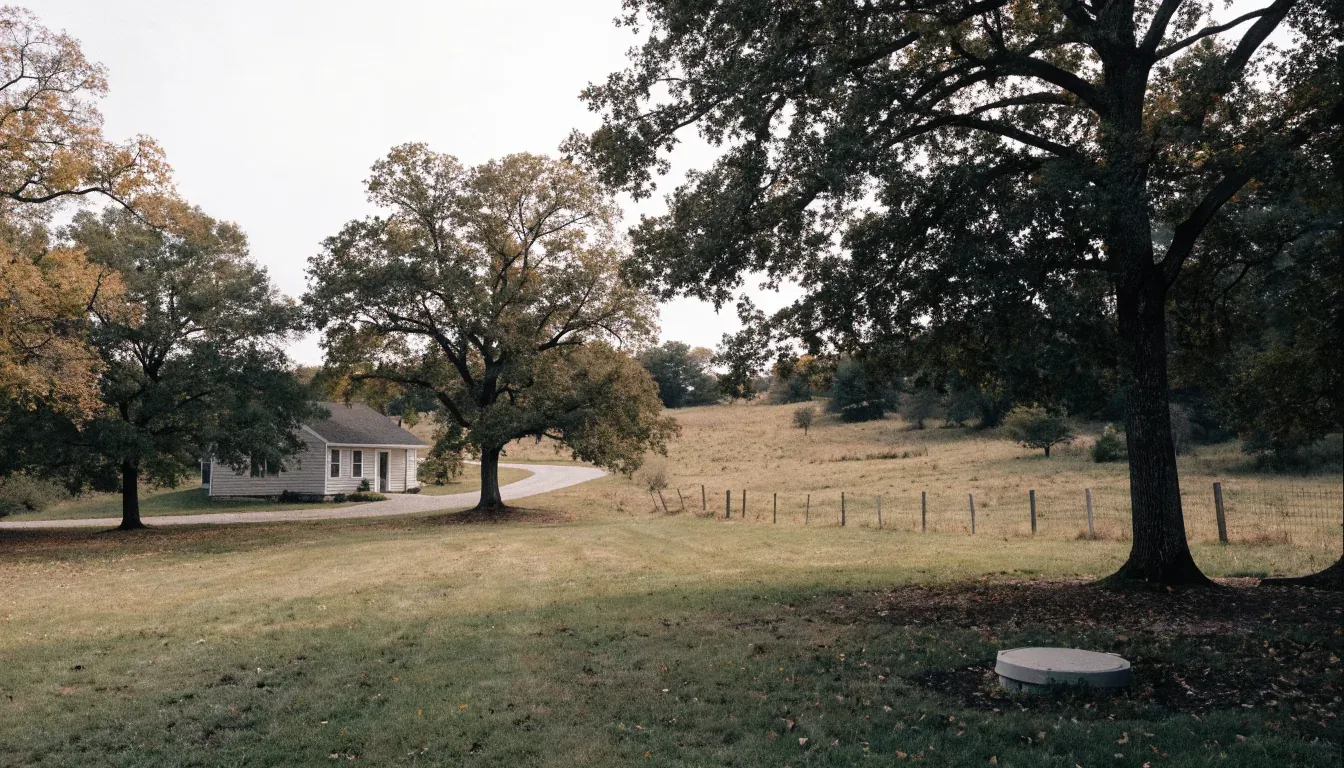

Septic service in De Soto, Missouri
De Soto owns its own sewage treatment plant on Joachim Creek and, unusually, its own septic rulebook. Inside the city limits a septic permit is issued under De Soto's city code by the City Manager as Code Official. Cross the city line and the same house, on the same shallow cherty ground, answers to Jefferson County's On-Site Sewage Treatment Code instead. Which desk you are standing at changes the plan set, the numbers a designer works to, and who is allowed to dig.
Who issues a septic permit in De Soto, MO?
Which desk you are at depends on the city line. Outside the city limits, on unincorporated ground, the permit comes from Jefferson County Code Enforcement in Hillsboro under Chapter 705, which by its own terms applies only to unincorporated land. Inside De Soto, septic permits are issued under city code Section 710.260 by the Code Official, who is the City Manager or the City Manager's authorized representative, so start at City Hall.
Jefferson County Code Enforcement. Phone (636) 797-5310. Their page: Jefferson County Code Enforcement.
Is the property on De Soto city sewer, or on a septic system?
The city runs the sewer itself. The De Soto Wastewater Treatment Plant on State Highway P is owned and operated by the City of De Soto under Missouri operating permit MO-0026662, built in 1986, designed for 1.4 million gallons a day against an actual flow of 1.16 million, discharging to Joachim Creek. Water and sewer are both run by the consolidated Public Works Department, so one call to (636) 586-3326 answers whether an address is on the city system.
Outside town the picture splits three ways. Valle Lake Sewer District is a separate utility with its own state permit, MO-0100749, discharging to Fletcher Branch. Jefferson County Public Sewer District serves much of the unincorporated county but excludes territory already served by other districts, and names Valle Lake as one of them. Everything left over is on a private system under county rules.
A sewer within reach turns the job from a system into a connection, and both rulebooks put a distance on it. Inside the city, De Soto's code makes connection a duty for a habitable property adjacent to and within 150 feet of a public right-of-way carrying a sewer, with 120 days to comply, and the city will extend a main to within 150 feet on request if none is that close. Outside, county Chapter 705 treats a sewer as available when any part of it is within 400 feet of the property line.
Two code books, one town line: what changes when you cross it
Section 710.260 of the city code adopts by reference the 2000 edition of the International Private Sewage Disposal Code, including Appendix A and Appendix B, for individual sewage disposal systems in the city, and names the Code Official as the City Manager or the City Manager's duly authorized representative. Inside the line, that is the document your plans are measured against. Section 710.270 makes a violation a misdemeanor, and each day it continues after notice counts as a separate offense.
Outside the line, none of that applies. Chapter 705 states its own scope: it governs on-site sewage treatment systems within the unincorporated land of Jefferson County. It stops at the city limit. Two houses a few hundred feet apart, on the same shallow soil over the same rock, answer to two code books, two offices and two sets of paperwork.
The practical difference is where the numbers live and who signs. The county's requirements are published text anyone can open, and the county package is the heavier one: a soil morphology report signed by a registered licensed on-site soil evaluator, a site plan under the seal and signature of a registered licensed designer, and an installer who stays on the hook for two years. The city's requirements sit inside a model code published in 2000 that has to be bought to be read, applied by a single Code Official at City Hall. So the first call is not the same call. Outside the line, ask the county what the submittal package looks like. Inside it, ask the City Manager's office which edition and appendices they are enforcing today, which numbers in it they apply, and what the permit costs.
The honest limit on that comparison: the 2000 International Private Sewage Disposal Code is a paid code council publication, and its text was not read for this page. The numbers that decide a design inside the city, separation to bedrock, minimum lot size, setbacks, are not established here and are not assumed to match the county's. The ordinance also inserts a dollar figure at one section of the adopted code, and with that code unread there is no way to know what the figure covers, so no permit fee is quoted here for either desk. Get both answers in writing before a designer draws anything, because a plan drawn to the wrong book is a plan drawn twice.
What the ground under De Soto does to a septic design
De Soto is where the county's shallow ground was defined. The typical pedons for both the Sonsac and the Moko soil series sit in the USGS DeSoto quadrangle: Sonsac moderately deep at 20 to 40 inches to bedrock, Moko very shallow to shallow at four to 20 inches. Those two series, with Useful, form the association covering 58 percent of the county survey area, and both rate Very limited for septic tank absorption fields with depth to bedrock at the maximum limitation value of 1.00. The High Ridge page carries what that depth problem means in full.
Set that against the county rules and the arithmetic is unforgiving. Chapter 705 wants three feet of soil between the bottom of the absorption system and high groundwater or bedrock, 48 inches of suitable soil for a conventional field, and no conventional system on a slope over 20 percent. Most upland ground here cannot meet that, so the practical answer is engineered: filled shallow trenches with two feet of natural separation and fill extending 20 feet past the trenches in all directions, low pressure pipe, drip, a sand mound, an aerobic unit meeting NSF International Standard 40 or 245, or a single family lagoon.
The Joachim Creek bottom through town is no easier. Haymond, Freeburg and Wilbur all rate Very limited on flooding and wetness at 1.00, and Haymond carries a poor filter rating at 1.00. County Table 602.1 also holds a treatment area 100 feet from the edge of a surficial sinkhole and 100 feet from a private water supply well, and a lagoon 500 feet, so a depression on the lot can move the field before anything else does.
One correction that gets repeated: De Soto is not on the Big River. The USGS gage in town is Joachim Creek at De Soto, number 07019500, and the city's discharge permit names Joachim Creek. What does reach here is the Southwest Jefferson County Mining Superfund site, which covers the whole county; homes on private wells testing above health based limits qualify for free point of use filtration.
What Jefferson County, MO requires just outside the city limits
On unincorporated ground the submittal package is the county's standard one, heavier than the state minimum. The soil morphology report has to bear the signature of a registered licensed on-site soil evaluator. The site plan has to carry the seal and signature of a registered licensed designer, showing every separating distance, including any distance to adjoining property within 100 feet of the proposed system. New lots on septic need two acres, 87,120 square feet, and one system per recorded lot.
State rule 19 CSR 20-3.060 is the floor the county builds on: no absorption trench in soil percolating slower than 120 minutes per inch, and a vertical separation of no less than one foot between the trench bottom and the limiting layer or seasonal high water table for a standard system, rising to four feet to bedrock for cherty clay soils in areas of severe geological limitations. The county's flat three feet is the stricter number to design to here.
Three county rules change what to expect on a specific job. A failing system has to be corrected or taken out of use within a period set by the Code Official that cannot exceed 60 days, and failure includes sewage backing into the house or surfacing on the ground. Adding a bedroom pulls the existing system into a stress loading test and visual inspection. The installer stays responsible for operation and maintenance for the first two years.
County licensing, bonding and insurance requirements sit on the Jefferson County, Missouri page rather than here.
What to have ready before you call a septic contractor
Having these ready is what lets an independent local septic contractor give a straight answer instead of a range.
Whether the address is inside De Soto city limits or in unincorporated Jefferson County. Everything else follows from that.
Whether the parcel is on city sewer, in Valle Lake Sewer District, in the county sewer district, or on a private system, and how far the nearest main is.
Bedroom count now and after the work. It sets the design load and triggers the county's stress loading test on an addition.
Any prior septic permit or as-built for the parcel, the tank location, and the last pump out date.
Whether the house is on a private well, and whether it has been tested.
Any sinkhole, spring or losing stream on or beside the lot, and how steep the field site is.
What you can see: standing water over the field, backup indoors, or odor after rain.
Where the facts on this page come from
- De Soto city code Section 710.260 adopts by reference the 2000 edition of the International Private Sewage Disposal Code, including Appendix A and Appendix B, for individual sewage disposal systems in the city, and names the City Manager or an authorized representative as Code Official. Source: City of De Soto, MO Code, Chapter 710, Article III, Section 710.260, read 2026-08-27.
- Section 710.270 makes a violation of that adopted code a misdemeanor, and each day a violation continues after notice has been served is a separate offense. Source: City of De Soto, MO Code, Section 710.270, read 2026-08-27.
- De Soto's code makes connection a duty for a property used for human habitation adjacent to and within 150 feet of a public right-of-way where a public sewer is located, with 120 days to connect after sewer is made available, and the city will extend a main to within 150 feet on request if none is that close. Source: City of De Soto, MO Code, Chapter 710, Article II, read 2026-08-27.
- The City of De Soto is the owner and continuing authority for the De Soto Wastewater Treatment Plant at 5911 State Highway P under state operating permit MO-0026662, design flow 1.4 MGD, actual flow 1.16 MGD, discharging to Joachim Creek. Source: Missouri Department of Natural Resources, Missouri State Operating Permit MO-0026662, read 2026-08-27.
- The De Soto plant was built in 1986 and is disinfected by high intensity ultraviolet light during the April to October recreational season. Source: City of De Soto, MO, Treatment Facility Overview, read 2026-08-27.
- Water and sewer are run by the consolidated De Soto Public Works Department, (636) 586-3326. Source: City of De Soto, MO, Public Works department page, read 2026-08-27.
- Valle Lake Sewer District is a separate utility outside De Soto with its own state operating permit MO-0100749, an oxidation ditch with UV disinfection discharging to Fletcher Branch. Source: Missouri Department of Natural Resources, Missouri State Operating Permit MO-0100749, read 2026-08-27.
- Jefferson County Public Sewer District serves a large part of unincorporated Jefferson County but excludes territory already served by other districts, naming Valle Lake Sewer District among them. Source: Jefferson County Public Sewer District homepage, read 2026-08-27.
- Jefferson County Chapter 705 applies to on-site sewage treatment systems located within the unincorporated land of Jefferson County. Source: Jefferson County, MO Code, Chapter 705, Article I, read 2026-08-27.
- A county application requires a soil morphology report signed by a registered licensed on-site soil evaluator and a site plan bearing the seal and signature of a registered licensed designer, showing all separating distances including any distance to adjoining property within 100 feet of the proposed treatment system. Source: Jefferson County, MO Code, Chapter 705, Article I, read 2026-08-27.
- The county requires three feet of soil between the bottom of the absorption system and high groundwater or bedrock, 48 inches of suitable soil for a conventional absorption system, and bars a conventional system on slopes greater than 20 percent. Source: Jefferson County, MO Code, Chapter 705, Article IV, read 2026-08-27.
- The county allows shallow trenches with two feet of natural soil separation, and fill on shallow sites extending a minimum of 20 feet beyond the drainfield trenches in all directions; permitted alternatives include low pressure pipe, drip distribution, sand mounds, aeration units and single family lagoons. Source: Jefferson County, MO Code, Chapter 705, Article IV, read 2026-08-27.
- Newly created county lots on an on-site system need a minimum of 87,120 square feet (two acres) with one system per recorded lot, and a sewer system is deemed available when any part of it is within 400 feet of the property line. Source: Jefferson County, MO Code, Chapter 705, Article IV, read 2026-08-27.
- County Table 602.1 sets 100 feet from a treatment area to a private water supply well and 100 feet from the edge of a surficial sinkhole, with 500 feet for a lagoon. Source: Jefferson County, MO Code, Chapter 705, Article VI, Table 602.1, read 2026-08-27.
- The county requires an aeration treatment unit to meet NSF International Standard 40 or 245 Class 1 effluent quality before an operating permit issues, gives a failing system no more than 60 days to be corrected or taken out of use, defines failure to include sewage backing up into the structure or surfacing on the ground, requires a stress loading test and visual inspection before a bedroom count increases, and makes the installer responsible for operation and maintenance for the first two years. Source: Jefferson County, MO Code, Chapter 705, Article I, read 2026-08-27.
- The typical pedons for both the Sonsac and the Moko soil series are located in the USGS DeSoto quadrangle; Sonsac is moderately deep, 20 to 40 inches to bedrock, Moko very shallow to shallow, four to 20 inches, and both rate Very limited for septic tank absorption fields with a depth to bedrock limitation value of 1.00. Source: USDA NRCS, Soil Survey of Jefferson County, Missouri, series descriptions and Table 13, read 2026-08-27.
- The Sonsac, Useful and Moko association covers 58 percent of the Jefferson County survey area, and the flood plain soils Haymond, Freeburg and Wilbur all rate Very limited for absorption fields on flooding and wetness at 1.00, with Haymond additionally rated a poor filter at 1.00. Source: USDA NRCS, Soil Survey of Jefferson County, Missouri, General Soil Map Units and Table 13, read 2026-08-27.
- The USGS gage in town is Joachim Creek at De Soto, MO, site number 07019500. Source: U.S. Geological Survey, National Water Information System, read 2026-08-27.
- The Southwest Jefferson County Mining Superfund site covers all of Jefferson County and names De Soto; under Operable Unit 5, residential properties on private wells are eligible for free point of use water filtration when testing finds lead, cadmium, arsenic, chromium or barium above health based limits. Source: U.S. EPA Region 7, Southwest Jefferson County Mining NPL Superfund Site fact sheet, June 2023, read 2026-08-27.
- State rule sets the floor the county exceeds: no absorption trench in soils with a percolation rate slower than 120 minutes per inch, and a vertical separation of no less than one foot between the trench bottom and the limiting layer or seasonal high water table for standard systems, rising to four feet to bedrock for cherty clay soils in areas of severe geological limitations. Source: Missouri Secretary of State, Code of State Regulations, 19 CSR 20-3.060, read 2026-08-27.
Several things are not established here. The 2000 International Private Sewage Disposal Code adopted by De Soto is a paid publication and its text was not read, so whether the city is stricter or looser than Jefferson County Chapter 705 on separation to bedrock, lot size and setbacks is unknown, and no septic permit fee is published here for either the city or the county. No ordinance was found stating whether De Soto allows a new septic system on a lot that could reach city sewer, beyond the 150 foot connection duty, so confirm that with the City Manager's office. Valle Lake Sewer District's service boundary was not verified, only its plant, permit and discharge point, so a specific parcel outside town has to be checked one at a time. The soil statements are at county grain plus the two type pedons in the DeSoto quadrangle; a specific address is answered only by the required soil morphology report. The city and county code text cited here was read in full on 2026-08-27 through a text extraction proxy pointed at the exact eCode360 URLs given in the sources, because that site blocks direct fetching.
Related
- Septic permits in Jefferson County, MO
- Septic in the St. Louis metro
- Septic design and soil evaluation
- Septic system installation
- Drainfield replacement
- Soil evaluation and perc test in Missouri
- What counts as a failed septic system
- Replacing a septic system
- The septic permit application
- Septic in House Springs, MO
- Septic in High Ridge, MO
Get a free quote from a septic contractor near De Soto
Tell us the county and the job. No email needed.
A marketing service, not a licensed contractor. Septic work is performed by independent local contractors.
Need the job done, not just the rule explained
Your request goes straight to an independent local septic contractor serving your Missouri county, usually within about an hour during the day, not a national lead list.
Tell us the county and the jobLast reviewed 2026-08-27.