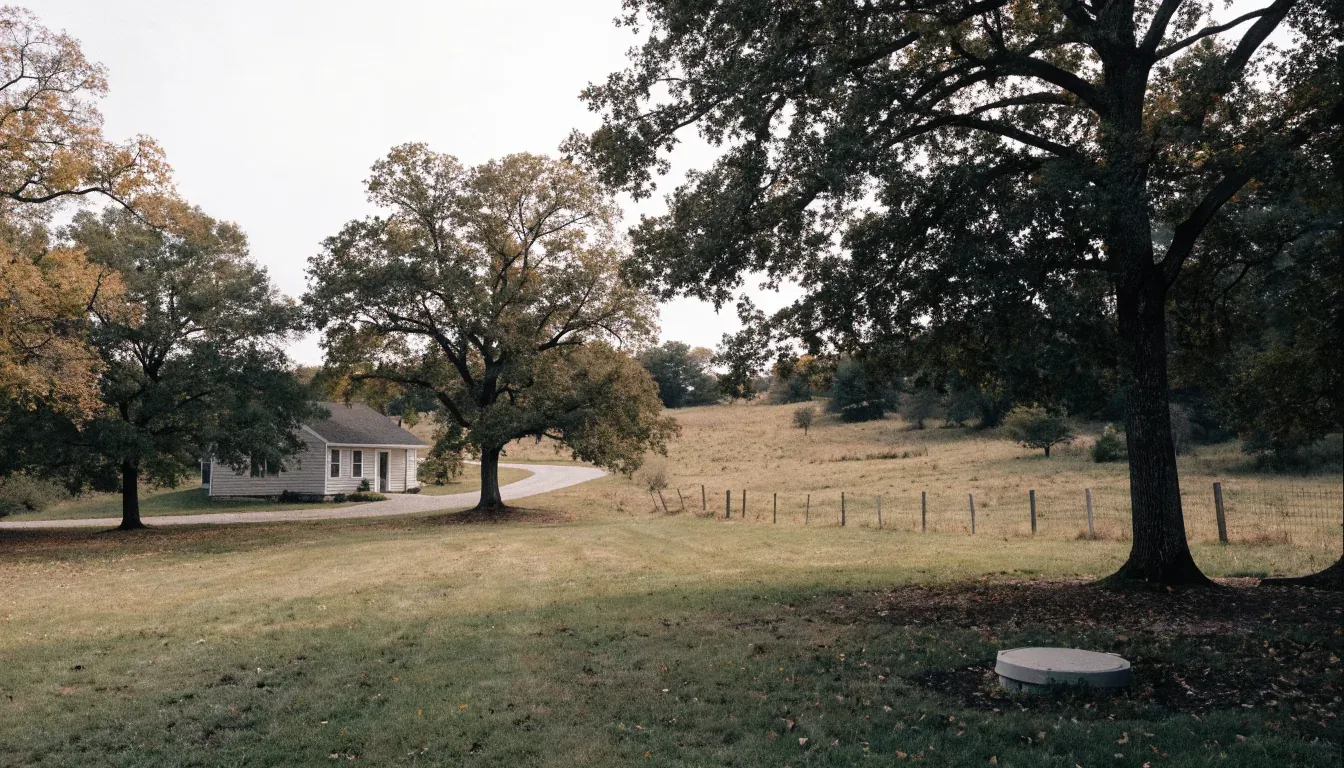

Septic tank installation in Washington, Missouri
Washington runs its own wastewater treatment plant on the Missouri River, sized for a design population equivalent of 40,000, so inside the city limits sewer is the answer and septic rarely comes up. The septic question starts at the city line and runs outward, into a county whose building department estimates it holds between 14,500 and 15,000 private onsite systems. Out there the permit does not come from a health department. It comes from the Franklin County Building Department in Union, under a county ordinance that took effect on October 1, 2025.
Who issues a septic permit in Washington, MO?
For property in the unincorporated county around Washington, the Franklin County Building Department issues the onsite sewage permit under the county's own ordinance, and the state lists that department as the county's permitting agency. Inside the Washington city limits the city runs its own sewer system, and the state notes that an incorporated city can fall outside the county authority and be deferred back to the state health department, so an owner inside the city should ask the city first. Whether the City of Washington issues any onsite permit of its own could not be confirmed for this page.
Franklin County Building Department. Phone (636) 583-6384. Their page: Franklin County Building Department.
Does public sewer reach your property near Washington, MO?
The City of Washington owns and operates its own wastewater treatment plant at 200 Kingsland Drive, on state operating permit MO-0025810, discharging to the Missouri River. It is built for a design population equivalent of 40,000 and a design flow of 4.0 million gallons a day, against an actual 2.4 million. Inside the city, wastewater is the city's job.
Outside the city limits the answer splits in both directions. A Washington mailing address is not the same thing as being in the city, and being in the city is not the same thing as having a main at your line. The Franklin County Master Plan records that parts of the unincorporated county are served by rural sewer providers, so a public connection can exist on ground an owner has always treated as septic ground. The reverse happens too, and people wait years for a hookup that is not coming.
Three checks settle it, and none of them costs anything.
Read the utility bill. A sewer charge, usually billed with water, means a public connection already exists.
Call the city utility office with your parcel number, not your street name: is the parcel inside the city limits, and is a sewer main available to it.
If the parcel is outside the city, call the Franklin County Building Department at (636) 583-6384 and ask whether a rural sewer provider serves that area.
Why the septic permit here comes from a building department
In Missouri the office that issues an onsite wastewater permit is usually a county health department, or the state health department where a county has no ordinance of its own. Franklin County is neither. The state lists the Franklin County Building Department in Union as the county's permitting agency, authority type Ordinance, meaning the county writes and enforces its own rules. Calling the health department first sends an owner to the wrong desk, because the building department holds this permit.
The city line moves the answer again. The Building Department permits and inspects only within unincorporated Franklin County, and county Planning and Zoning covers only unincorporated areas, so city ground sits outside both. The state adds that an incorporated city inside an ordinance county may fall outside that county authority, with the permit process deferred back to the state. Inside the city limits, ask the city first.
How many septic systems are out here, and why the number matters
The Franklin County Master Plan carries the figure the rest of this page hangs on. The county building department estimates there are between 14,500 and 15,000 private onsite septic systems in Franklin County. That is the county's own estimate, not a trade guess, and it is the installed base the ground around Washington sits inside.
Read it two ways. Septic is ordinary here, so nobody working a system on your lot is doing anything unusual for this county. It is also the size of the population the new rules now govern, because the county replaced its onsite sewage ordinance effective October 1, 2025. Every one of those systems that fails or gets replaced from that date forward comes in under the new text, and the installer you call may still be quoting the old one.
The count also limits what any page can tell you. Those thousands sit on river bottom that floods, loess hillside and cherty upland, and a county-wide average across that spread is useless on one lot.
The three acre rule on new unincorporated ground
How does the county handle soil that will not take a conventional system? Not with a special engineered standard on a web page. The answer is written into the zoning map as density. Across the Franklin County Unified Land Use Regulations the same pair of numbers repeats, district after district, 41 times in one article: a subdivision lot without central water and sewer service must be at least three acres, while a lot with central water and sewer can be one acre.
That is a design constraint, not trivia. On new unincorporated ground around Washington, three acres is the floor a septic designer works inside, and the lot area quietly does work a treatment upgrade would otherwise have to do: room for the field, room for a replacement field later, and distance from wells and water.
On an older lot platted long before those rules the arithmetic runs the other way. The area is whatever was platted, a failed field cannot always be replaced in kind, and the options narrow toward a smaller footprint or different treatment. Have that conversation at the start, not after a tank is ordered.
Which soils sit under Washington, and how they rate
Washington sits on the south bank of the Missouri River, inside USDA soil survey area MO071, the Soil Survey of Franklin County, Missouri. Read through the USDA NRCS Web Soil Survey on 2026-08-27, these units cover the most ground in and around town, with the septic tank absorption field rating NRCS gives each.
Wrengart silt loam, 5 to 9 percent slopes, and Wrengart silt loam, 8 to 15 percent slopes, eroded. The two units covering the most ground here. Both Very limited.
Menfro silt loam, 5 to 9 percent slopes, eroded, and Menfro silt loam, 9 to 14 percent slopes, eroded. The loess hill soils. Very limited and Somewhat limited respectively.
Menfro silt loam, 2 to 5 percent slopes. The gentlest loess unit. Somewhat limited, the highest rating that appears around Washington.
Haymond silt loam, 0 to 3 percent slopes, frequently flooded. The bottomland unit. Very limited.
Haynie-Treloar-Blake complex, 0 to 2 percent slopes, frequently flooded, and Lowmo silt loam, 0 to 2 percent slopes, occasionally flooded. River flats. Very limited.
What those ratings do to a septic design
The reasons matter more than the ratings. Wrengart is marked down for depth to saturated zone and slow water movement: a restrictive layer at about 36 inches, a seasonal wet zone from around 33 inches, and a drainage class of moderately well drained rather than well drained. Menfro carries slow water movement alone, no restrictive layer recorded, which is why it rates higher. Haymond is marked down for flooding first, slow water movement second.
Of the map units around Washington whose main component carries this rating, 31 rate Very limited and two rate Somewhat limited, both Menfro. The only two not rated are Water and a quarry pit. Nothing around this town rates Not limited.
Very limited does not mean no system. It means a plain trench field in native soil is unlikely to be the design without help, and it says what the soil evaluation will argue about: the wet season and depth to the restrictive layer, not a percolation number alone. Map units are drawn whole hillsides at a time, so your lot still decides it. An evaluation on the lot settles it.
Franklin County's onsite sewage ordinance is not posted online, so its setbacks to wells, property lines and streams, and its rules on soil morphology versus a percolation test, are not restated here. Ask the Building Department for the ordinance.
What Franklin County requires, and how to get it in writing
The County of Franklin On-Site Sewage Disposal Systems Ordinance and Regulations was adopted and amended on September 23, 2025, effective October 1, 2025. Anything you were told before that date is worth re-checking.
The county publishes neither its fee schedule nor its inspection guidelines online. Its own page says to contact the department for both, so the permit fee is not a figure this page can quote and no one should quote it from memory. Call (636) 583-6384 or write [email protected], ask for the ordinance and the current fee list, and keep the reply.
Because Franklin County writes its own ordinance, what it requires can go past the state minimum standard, and it says nothing about Warren, St. Charles or Jefferson County. The Franklin County, MO page carries the county-wide picture.
What to have ready before you call a septic contractor
A request through this site goes to an independent local septic contractor working Franklin County. A quote comes from someone standing on the lot with the soil report, never from a web page.
A first call goes faster with these in front of you.
The parcel number, and whether the parcel is inside or outside the Washington city limits.
Whether a sewer charge appears on the utility bill, and whether a rural sewer provider serves the area.
Lot size, and roughly when it was platted, because the three acre and one acre lines decide what fits.
Anything on record about the existing system: the permit, an as-built drawing, where the tank lid is, when it was last pumped.
The symptom, if there is one: slow drains, standing water over the field, backups after heavy rain, odor at the tank.
Where the well sits, on your lot and on the lots next to you.
Where the facts on this page come from
- The Franklin County Building Department issues permits and inspects new construction only within unincorporated Franklin County. Source: Franklin County, MO, Building Department, read 2026-08-27.
- Franklin County's septic rules are its own county ordinance, the County of Franklin On-Site Sewage Disposal Systems Ordinance and Regulations, adopted and amended September 23, 2025, effective October 1, 2025. Source: Franklin County, MO, Building Department, building codes list, read 2026-08-27.
- Franklin County does not publish its septic fees or inspection guidelines online: its page says to contact the department for a copy of each, and lists (636) 583-6384 and [email protected] as the contacts. Source: Franklin County, MO, Building Department, read 2026-08-27.
- The State of Missouri lists the Franklin County Building Department as the county's onsite wastewater permitting agency, with authority type Ordinance, and notes the county may have requirements beyond the state minimum construction standards. Source: Missouri Department of Health and Senior Services, OWTS Construction Permit Required, read 2026-08-27.
- An incorporated city inside a county that has an onsite ordinance may not fall under that county authority, in which case the local permitting authority defers the permit process back to the state health department. Source: Missouri Department of Health and Senior Services, OWTS Construction Permit Required, read 2026-08-27.
- Most Missouri counties on the state permitting-agency list are served by a county health department or by the state health department itself, rather than by a building department. Source: Missouri Department of Health and Senior Services, OWTS Construction Permit Required, full agency list, read 2026-08-27.
- The county building department estimates there are between 14,500 and 15,000 private onsite septic systems in Franklin County. Source: Franklin County Master Plan, read 2026-08-26.
- Parts of the unincorporated county are served by rural sewer providers, so a public sewer connection may be available where a homeowner assumes it is not. Source: Franklin County Master Plan, read 2026-08-26.
- The City of Washington owns and operates the Washington Wastewater Treatment Plant at 200 Kingsland Drive, permit MO-0025810, design flow 4.0 million gallons per day, actual flow 2.4 million gallons per day, design population equivalent 40,000, discharging to the Missouri River. Source: Missouri Department of Natural Resources, Missouri State Operating Permit MO-0025810, read 2026-08-27.
- In unincorporated Franklin County, the minimum lot area for subdivisions without central water and sewer service is three acres, against one acre where central water and sewer service exists. That wording repeats 41 times across the zoning district sections. Source: Franklin County Unified Land Use Regulations, Article 7, Zoning Districts and Zoning Map, read 2026-08-27.
- Franklin County Planning and Zoning regulates land divisions, lot-line adjustments, zoning districts and floodplain administration in unincorporated areas only. Source: Franklin County, MO, Planning and Zoning Department, read 2026-08-27.
- Franklin County, Missouri is USDA soil survey area MO071. The map units covering the most area in and around Washington are Wrengart silt loam 5 to 9 percent slopes, Wrengart silt loam 8 to 15 percent slopes eroded, Menfro silt loam 5 to 9 percent slopes eroded, Menfro silt loam 9 to 14 percent slopes eroded, and Haymond silt loam 0 to 3 percent slopes frequently flooded. Source: USDA NRCS Web Soil Survey, survey area MO071, Soil Survey of Franklin County, Missouri, tabular query through Soil Data Access, read 2026-08-27.
- Septic tank absorption field ratings for those units: Wrengart silt loam 5 to 9 percent slopes, Very limited; Wrengart silt loam 8 to 15 percent slopes eroded, Very limited; Menfro silt loam 5 to 9 percent slopes eroded, Very limited; Menfro silt loam 9 to 14 percent slopes eroded, Somewhat limited; Menfro silt loam 2 to 5 percent slopes, Somewhat limited; Haymond silt loam 0 to 3 percent slopes frequently flooded, Very limited; Haynie-Treloar-Blake complex 0 to 2 percent slopes frequently flooded, Very limited; Lowmo silt loam 0 to 2 percent slopes occasionally flooded, Very limited. Source: USDA NRCS Web Soil Survey, survey area MO071, Soil Survey of Franklin County, Missouri, tabular query through Soil Data Access, interpretation ENG - Septic Tank Absorption Fields, read 2026-08-27.
- The limiting reasons NRCS records for the septic tank absorption field rating: Wrengart, depth to saturated zone and slow water movement; Menfro, slow water movement; Haymond, flooding and slow water movement. Source: USDA NRCS Web Soil Survey, survey area MO071, Soil Survey of Franklin County, Missouri, tabular query through Soil Data Access, interpretation ENG - Septic Tank Absorption Fields, subrule detail, read 2026-08-27.
- The Wrengart component is moderately well drained, hydrologic soil group C, with a restrictive layer recorded at 91 centimeters (about 36 inches) and a seasonal wet zone from 84 centimeters (about 33 inches). The Menfro component is well drained, hydrologic soil group C, with no restrictive layer recorded. Source: USDA NRCS Web Soil Survey, survey area MO071, Soil Survey of Franklin County, Missouri, tabular query through Soil Data Access, component and restriction tables, read 2026-08-27.
- Across the map units around Washington whose major component (50 percent or more of the unit) carries the septic tank absorption field interpretation, 31 rate Very limited, two rate Somewhat limited (both Menfro), and two are Not rated (Water, and Pits, quarry). None rate Not limited. Source: USDA NRCS Web Soil Survey, survey area MO071, Soil Survey of Franklin County, Missouri, tabular query through Soil Data Access, interpretation ENG - Septic Tank Absorption Fields, aggregated across map units intersecting the Washington area, read 2026-08-27.
Four things could not be established for this page, read 2026-08-27. First, the text of the County of Franklin On-Site Sewage Disposal Systems Ordinance and Regulations is not published online, so its setbacks, soil testing rules, installer requirements, minimum absorption area and permit fees are unknown here and are stated nowhere on this page. Get them from the Building Department at (636) 583-6384. Second, the City of Washington's own municipal code could not be retrieved, so whether the city requires sewer connection inside its limits, prohibits septic systems there, or issues any onsite permit itself is unknown. Third, the soil ratings on this page come from the USDA survey for Franklin County (MO071) read through Soil Data Access, which maps at survey scale, whole hillsides at a time. No site-specific soil evaluation for any Washington lot was read, and a survey rating is not a substitute for one. Fourth, the Franklin County Master Plan records that rural sewer providers serve parts of the unincorporated county but does not name which providers serve which areas, so that has to be asked locally.
Related
- Septic permits in Franklin County, MO
- Septic in the St. Louis metro
- Septic system installation
- Septic design and soil evaluation
- Drainfield replacement
- Soil evaluation and perc test in Missouri
- Replacing a septic system
- Signs of a failed septic system
- Look up an existing septic record
- The Missouri septic permit, start to finish
Get a free quote from a septic contractor near Washington
Tell us the county and the job. No email needed.
A marketing service, not a licensed contractor. Septic work is performed by independent local contractors.
Need the job done, not just the rule explained
Your request goes straight to an independent local septic contractor serving your Missouri county, usually within about an hour during the day, not a national lead list.
Tell us the county and the jobLast reviewed 2026-08-27.