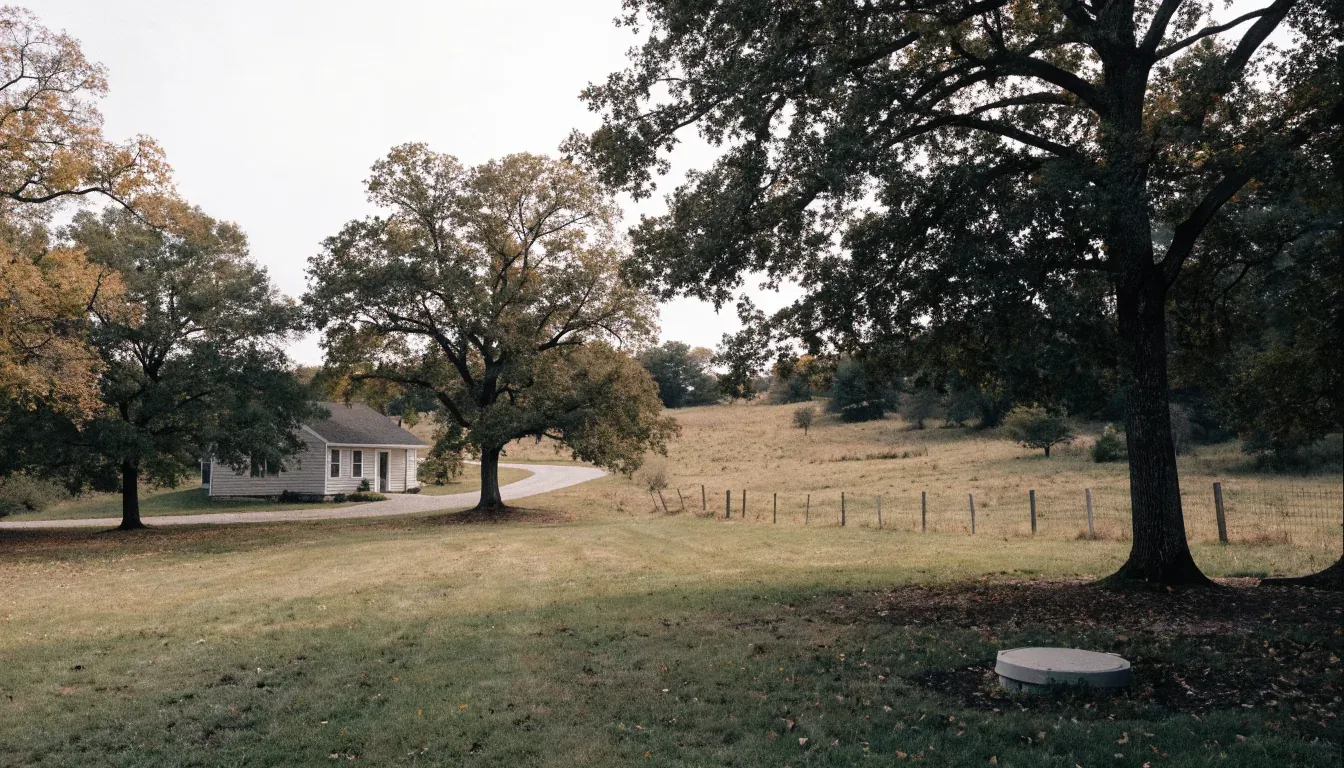

Septic installation and replacement in Christian County, Missouri
Christian County adopted its own onsite wastewater ordinance in 1992 and last revised its construction standards in October 2015, and it is one of the counties that licenses installers itself. Anyone installing for hire here needs a Christian County license on top of their state registration, and that license expires every two years with a short renewal exam. A homeowner doing the work on their own system does not need that license, but they do still need the permit. A rural build here can involve three different agencies: the health department for septic, county building regulations for the structure, and the Department of Natural Resources for a well.
Who issues a septic permit in Christian County, MO?
The Christian County Health Department, Environmental. That is the office to call before anything else, because in Missouri the permitting authority is not the same kind of agency in every county, and assuming it is the health department wastes a week in the counties where it is not.
Phone (417) 581-7285. Their page: Christian County Health Department, Environmental.
Source: Missouri Department of Health and Senior Services, onsite wastewater construction permit authority lookup for Christian County, read 2026-09-12. Fees, forms and requirements change, and this county is the only current source for its own.
What does Christian County require beyond the state standard?
- Any person engaged in the construction or renovation of any wastewater treatment system must obtain a construction permit from the Christian County Health Department. Source: Christian County Health Department, wastewater, read 2026-08-26.
- The county adopted its own onsite wastewater ordinance, 043-1992, and its current construction standards were revised on 1 October 2015, published together as the health department’s onsite standards book. Source: Christian County Health Department, OWTS Standards Book, read 2026-08-26.
- Anyone installing a system for hire must hold a Christian County license in addition to state registration, and that county license expires every two years with a short renewal exam. Source: Christian County Health Department, fee schedule, read 2026-08-26.
- A homeowner is not required to be licensed by the department to install, add to, alter or repair the private wastewater system on their own property, but the permit is still required. Source: Christian County Health Department, OWTS Standards Book, read 2026-08-26.
- The permit application has to include the soil scientist site evaluation report, the installer’s sketch and the non-refundable application fee, so the soil work is part of the application rather than a later step. Source: Christian County Health Department, OWTS Standards Book, read 2026-08-26.
- Well permits in this county are issued by the Missouri Department of Natural Resources rather than by the county, so a rural build involves more than one agency. Source: Christian County Building Regulations, read 2026-08-26.
Missouri lets a county adopt standards more restrictive than the state's, so a requirement here is not evidence of the same requirement one county over.
Source: Missouri Department of Health and Senior Services, Onsite Wastewater Treatment, read 2026-09-12.
What is the ground like in Christian County?
Ozark karst, and it is the controlling fact for septic design here. Christian County sits south of the Missouri River on the Springfield Plateau, where thin residual soil sits directly on fractured, cavernous limestone. Effluent that reaches bedrock in this ground is not treated by soil on the way: it enters groundwater through solution channels. That is why the separation between the bottom of a system and bedrock matters more here than percolation rate alone.
That matters because the soil decides the system. A standard system needs at least one foot between the trench bottom and the limiting layer or seasonal high water table, rising to four feet to groundwater or bedrock in highly permeable soils and in cherty clay soils in areas of severe geological limitations, and a percolation rate slower than sixty minutes per inch pulls a registered engineer onto the design.
The soil evaluation is what settles it for your particular lot.
Source: 19 CSR 20-3.060(5)(A)2., Missouri Code of State Regulations, read 2026-09-12.
Which towns does this cover?
Christian County has Ozark as its county seat. Places served include Ozark, Nixa, Clever, Sparta, Billings, Fremont Hills, Highlandville, Saddlebrooke, Chadwick, Spokane. Anywhere in the county not on a public sewer is on a system this page applies to.
Who is allowed to do the work here?
An installer registered with the Missouri Department of Health and Senior Services. That is a state requirement rather than a county one. The statute carrying it also carries a large-lot exclusion for some single-family lots of three acres or more, on strict conditions, and a county regulating under its own ordinance can require its own permit and its own registration regardless, which is what the collar counties around St. Louis do. Some counties add their own licensing on top of the state registration, which is one more reason to ask the permitting authority what they require before you sign anything.
Who is allowed to do the work covers what registration means here.
Source: Section 701.031, Revised Statutes of Missouri, read 2026-09-12.
What we could not confirm for this county
Whether the county wastewater ordinance reaches inside incorporated city limits, or applies only to unincorporated areas, was not established, and which parts of Nixa and Ozark are on public sewer was not mapped. The health department publishes a current fee schedule, and fees change, so no figure is repeated here. Confirm both with the department.
Get a free quote from a septic contractor in Christian County
Tell us the county and the job. No email needed.
A marketing service, not a licensed contractor. Septic work is performed by independent local contractors.
Need the job done, not just the rule explained
Your request goes straight to an independent local septic contractor serving your Missouri county, usually within about an hour during the day, not a national lead list.
Tell us the county and the jobLast reviewed 2026-09-12.